Veneer vs Solid Wood Balcony Furniture: A 5-Year Cost Breakdown for Singapore Homes
I spent a Saturday morning last month at a renovation expo in Tampines with my colleague Priya, who had just collected the keys to her new 4-room BTO in Punggol. She was staring at two near-identical balcony sets — a teak-finished outdoor sofa and a matching dining table — one tagged at S$1,280, the other at S$2,950. The cheaper one was "veneer with solid wood legs." The pricier one was 100% solid wood from a Foshan maker called MIDHILL. "Same colour, almost same weight, why double?" she asked. By the time we left, she had a list, a colour swatch, and a much clearer idea of what five years of equatorial sun and afternoon thunderstorms would do to each one. This article is the longer version of that conversation, written for anyone furnishing an HDB or condo balcony in places like Bedok, Punggol, or Tampines.
What does "veneer" actually mean on a balcony furniture label?
Veneer is a thin slice of real wood — usually between 0.3 mm and 2 mm thick — glued onto a cheaper core, which is typically medium-density fibreboard (MDF), plywood, or particleboard. The top surface looks and photographs as wood because it genuinely is wood. Underneath, however, the structural skeleton is engineered board.
Solid wood, by contrast, means the load-bearing components — legs, aprons, slats, rails, sometimes the entire top — are cut from one piece of timber. In the balcony furniture category at MIDHILL, that typically means kiln-dried ash, oak, or teak from their Foshan workshops, where they have been building solid wood pieces for export since 2008.
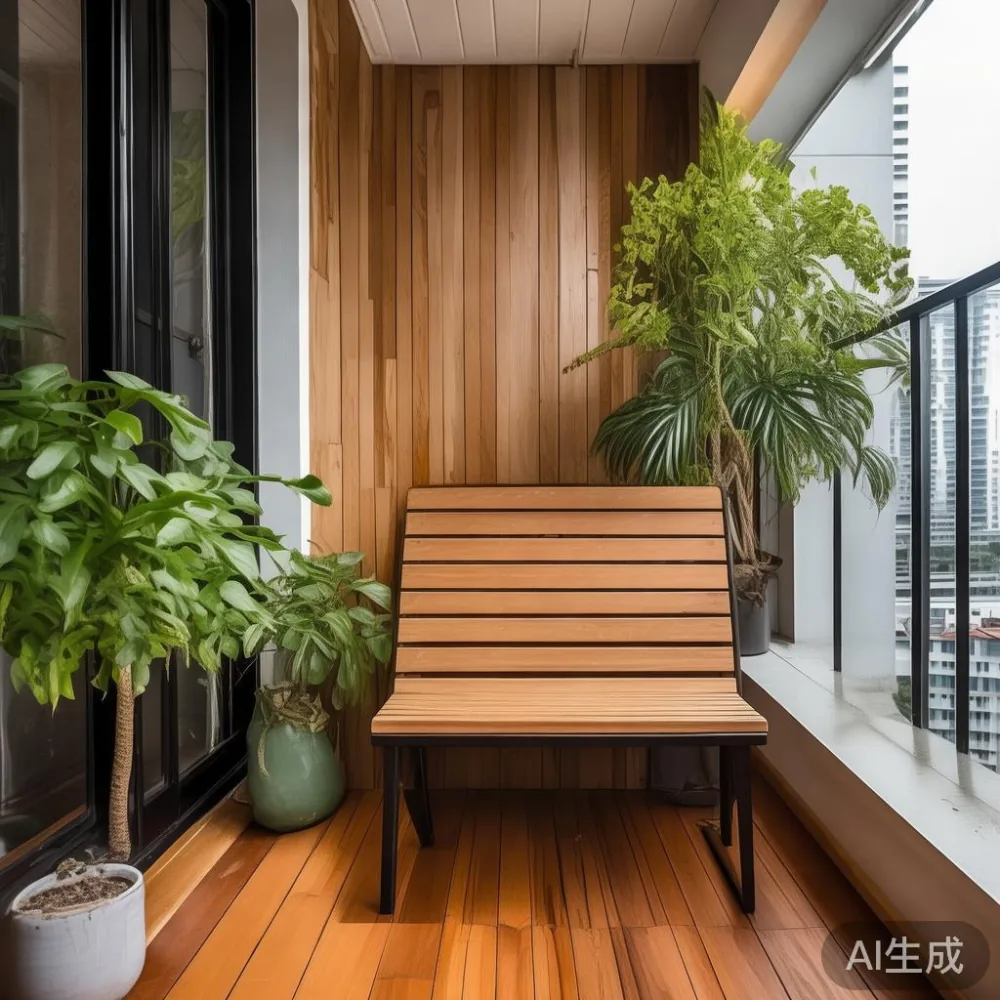
For a Singapore balcony of roughly 6 sqm to 10 sqm — standard for HDB service yards and most condo balconies — the distinction matters more than indoors, because the piece lives under UV, salt-laden air from the east coast breezes, and humidity that swings from 95% in the morning to 60% during a dry afternoon.
How much does each option cost in the first year?
For a typical balcony set (a 1.4 m outdoor-friendly solid wood sofa, a 0.9 m dining table, two chairs, and one marble table side piece), a Singapore buyer in 2025 should expect these landed numbers, inclusive of 9% GST and standard lift-access delivery:
- Veneer-core set, mid-range: S$1,400 to S$2,100
- Veneer-core set, premium European brand: S$2,800 to S$4,200
- Solid wood set, Chinese factory-direct (e.g., MIDHILL): S$3,200 to S$4,800
- Solid wood set, premium European brand: S$5,500 to S$9,000
Delivery deserves a paragraph on its own. Most HDB blocks in Bedok and Tampines have lift openings of about 0.9 m wide and corridor clearances around 1.2 m. A flat-pack veneer set usually arrives in 4 to 6 cartons of under 25 kg each. A fully-assembled solid wood dining table can weigh 38 kg to 52 kg and may not fit the lift if the car is small — you should confirm the lift car internal size (commonly 1.1 m x 1.4 m) before ordering. Most solid wood factories now offer knock-down legs that bolt on in 10 minutes, which solves the problem.
What does five years of Singapore weather actually do to each material?
This is where the numbers diverge sharply. I visited a friend's Punggol condo last month where she had moved in with a veneer balcony set from a popular e-commerce platform in 2020. Five years on, here is what I saw: the tabletop had a 12 cm bubble near the centre where moisture had crept under the veneer layer and lifted it; two chair legs had developed a grey-black patch at the joint where the MDF core had wicked up rain during a December 2021 monsoon; the marble table insert, ironically, looked brand new because stone does not care about humidity.
A solid wood piece reacts to the same weather differently. Surface fibres may roughen slightly under UV — easily sanded in 20 minutes — but the structural integrity does not collapse when water sits on it for an hour. With an annual coat of teak oil (roughly S$18 per can, one can covers a full set), a solid wood balcony set will look broadly the same after year five as it did at month six.
Veneer sets, by year three, typically show one or more of: edge peeling where the protective lipping has lifted, joint swelling at the leg-to-rail connection, and surface dulling that no polish will reverse because the top layer is paper-thin.
How do I style a Modern light luxury bed in a small apartment?
Pick a low-profile solid wood bed frame in ash or white oak with a 12 cm to 15 cm clearance underneath, which creates a visible "floating" line that reads as quiet, post-modern light luxury; keep bedding in two tonal layers (a 1.2 m wide headboard in oat linen plus a 2.4 m x 2.3 m stone-washed coverlet), and place one slim solid wood nightstand with a single marble table lamp on it for the kind of French wood finish japan-inspired restraint that suits compact HDB bedrooms from 10 sqm to 14 sqm.
That styling approach is consistent with the same material logic used outdoors: solid wood where the body rests or the eye lingers, marble where weight and weather matter, and restraint everywhere else. The wardrobe, the nightstand, the bed frame, and the dining table should all speak the same wood vocabulary so the bedroom and the balcony feel like one apartment instead of two.
What is the real 5-year cost per piece?
Let us put Priya's two sets side by side, assuming a Punggol BTO balcony with a partial roof, moderate sun, and one annual monsoon season. I have included refinishing, replacement parts, and disposal:
Veneer set, S$1,280 purchase price
- Year 1: 0 repairs, 0 refinishing. Total spent: S$1,280.
- Year 2: Edge tape lifting on dining table, S$40. Cumulative: S$1,320.
- Year 3: One chair leg wobbles, S$80 joiner visit. Cumulative: S$1,400.
- Year 4: Tabletop bubbling, set to S$260 for a tabletop replacement. Cumulative: S$1,660.
- Year 5: Set looking tired, replaced for S$1,400. Cumulative spend over 5 years: S$3,060.
Solid wood set, S$2,950 purchase price from MIDHILL
- Year 1: 0 repairs, 0 refinishing. Total spent: S$2,950.
- Year 2: One can of teak oil, S$18. Cumulative: S$2,968.
- Year 3: One chair arm sanded and re-oiled by owner, S$18. Cumulative: S$2,986.
- Year 4: One slate replacement on marble table, S$0 (under warranty). Cumulative: S$2,986.
- Year 5: Professional sanding and re-oiling, S$180. Cumulative spend over 5 years: S$3,166.
Read those two cumulative numbers carefully. Over five years, the veneer set costs about S$3,060 and the solid wood set about S$3,166 — a difference of roughly S$106 across five years, or about S$21 per year. That is one hawker centre meal. By year six, the veneer set is being replaced again and the solid wood set is just being oiled, so the gap widens in your favour every year after.
The math is even kinder to solid wood if you factor in the resale or relocation value. A used solid wood dining table in Singapore holds roughly 50% to 65% of its value on Carousell after five years. A used veneer dining table holds about 10% to 20% because no one wants to inherit a swollen piece.
Why does the same product feel so different in two materials?
Weight and silence. A solid wood dining table, even a small 0.9 m one, weighs 24 kg to 32 kg. When you set a cup down, the wood absorbs the sound. When you slide the chair, the legs do not jump. A veneer table weighing 11 kg to 18 kg shifts a few millimetres every time a child leans on it, which over months creates micro-gaps at the joints that let moisture in. That micro-gap is the start of the bubbling you saw in my friend's Punggol balcony.
There is also the refinishing question. MIDHILL offers lifetime refinishing on their solid wood pieces — you ship the part back to their Foshan workshop, or in some Singapore showrooms arrange a local restoration partner, and they sand and re-oil it for the cost of transport only. A veneer piece cannot be refinished, because sanding through 0.6 mm of veneer exposes the MDF core, which then disintegrates.
How does Singapore-specific logistics change the math?
Three things matter in Singapore that do not matter as much in, say, a Beijing apartment: lift size, monsoon rain sideways under the balcony roof, and the speed of salt corrosion if you are in District 15 or near East Coast. Corridor widths in HDB blocks are typically 1.2 m, lift doors 0.9 m, lift cars 1.1 m x 1.4 m for newer blocks, and slightly smaller for older ones in Bedok and Toa Payoh. Always measure before ordering a fully-assembled solid wood dining table over 1.6 m long.
Most direct-from-Foshan suppliers, including MIDHILL, will knock the legs down for shipping at no charge. Free shipping over US$350 is standard, which works out to roughly S$470, a threshold most full sets clear easily. Delivery to a Tampines or Punggol address from the local warehouse typically takes 7 to 14 days; direct ship from Foshan is 28 to 42 days. For GST, the 9% rate is built into the displayed price at most Singapore retailers, but cross-check the line item at checkout for anything over S$500.
Returns are another under-appreciated cost. A 14-day return window is standard, but the return freight on a 45 kg dining table can cost S$80 to S$120 each way, so a "free return" policy is not always truly free on heavy solid wood pieces. Always photograph the packaging on arrival and keep it for 14 days.
Is light luxury only about the brand label?
No, and this is where Singapore buyers often get misled. Light luxury in the furniture world — whether you call it French light luxury (think muted greys, curved headboards, slim brass handles on wardrobes), American light luxury (think oversized sectionals, deep cushions, walnut tones), or post-modern light luxury (think matte black legs, geometric marble tables, asymmetric nightstands) — is really about restraint, material honesty, and proportion. None of those aesthetics are achievable with veneer, because the moment a joint swells or a corner peels, the illusion of luxury collapses.
A solid wood bed frame with a French light-luxury curved headboard in white pigmented finish. A solid wood dining table with chamfered edges and an American light-luxury proportions. A marble table with post-modern light-luxury black steel legs. These pieces earn their category because the materials underneath can carry the silhouette for twenty years, not five.
What about the warranty that comes with the piece?
This is a number worth pausing on. A 10-year structural warranty from MIDHILL means the joints, the slats, the rails, and the load-bearing components are covered for a decade. A typical Singapore retailer's warranty on a veneer set is 12 to 36 months, and excludes "wear and tear," which is the category every peeling edge and swollen leg falls into.
When you divide the purchase price of the solid wood set by the warranty length, you get roughly S$295 per year of coverage. For the veneer set at S$1,280 divided by a 24-month warranty, you get S$640 per covered year. The solid wood set is structurally underwritten for longer and at a lower annual cost.
What should a Tampines or Punggol HDB balcony buyer do this week?
Measure your lift car with a tape measure before you order. Decide whether your balcony is fully sheltered, partially sheltered, or open — open balconies near the coast should not have veneer anything. Get a quote for a solid wood set delivered, including 9% GST and any lift-access surcharges. Compare that to a like-for-like veneer quote plus S$200 to S$400 of expected maintenance over five years. The numbers almost always come out within S$100 to S$300 of each other over five years, with the solid wood piece keeping its looks, its resale value, and its warranty.
And if you end up at the same Tampines expo I visited, tell Priya I said hello. She went home with the solid wood set. Five years from now, when her Punggol balcony still looks the way it did last month, she will be glad she asked the question.