Balcony Furniture in Singapore: How Humidity Really Affects the Solid Wood You Bring Home
I keep a small notebook by my front door in Tampines, and on every wet afternoon between May and September I scribble down the same thing: how the wood furniture on my balcony feels under my palm. Last month I visited a friend's new Punggol condo and ran my hand across her imported oak balcony furniture — the surface had developed a slight woolly texture, the drawers of her outdoor side cabinet were a millimetre stiff, and a hairline crack had appeared along one leg of the dining stool. She turned the piece around and clearly found the maker's stamp. None of it was cheap. None of it was meant to fail in year two. The reason it was failing was sitting in the air around us — 78 to 92 percent relative humidity, day after day, the kind of moist tropical air that every Singapore HDB flat, condo, and landed house pumps through its balcony doors for ten months of the year.
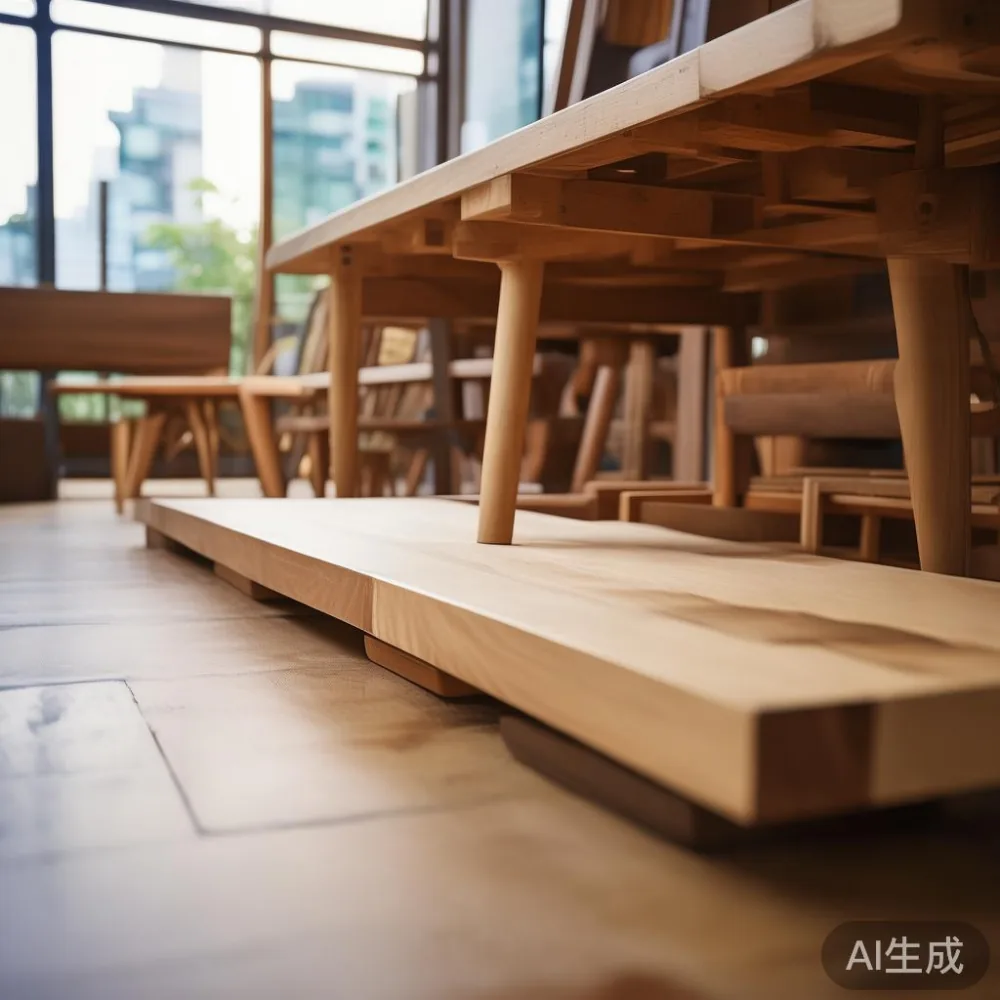
Why is humidity the single biggest enemy of wood furniture in Singapore?
Wood is hygroscopic. It absorbs water vapour when the air is damp and releases it when the air is dry. In a Tampines HDB corridor or a Bedok condo living room, that movement happens every single day. When moisture content swings more than 4 to 6 percent across a season, solid wood swells, shrinks, cups, and cracks. Engineered boards with thin veneers — MDF, particleboard, plywood with a 0.3 mm face — cope even worse, because the thin surface layer moves at a different rate from the substrate beneath it. The balcony is the harshest spot in any Singapore home: part indoor, part outdoor, no air-conditioning, direct afternoon sun on one side, monsoon rain splashing the rail on the other. A normal balcony sees humidity cycles from 55 percent at noon to 95 percent at midnight, often within twelve hours. No other room in your home behaves like that, which is why balcony furniture is its own product category, not just smaller living room furniture moved outside.
What humidity numbers actually matter when you are buying?
Two numbers matter more than any other. The first is the moisture content of the wood at the moment of manufacture: it should sit between 8 and 12 percent for furniture that will live in a Singapore home. Anything above 14 percent is shipping green; it will shrink in your corridor and split in your bedroom. The second is the wood species. Teak, white meranti, and shorea have a tangential shrinkage of 1.0 to 1.2 percent per 1 percent moisture change; European oak sits around 1.5 to 1.8 percent; beech is even higher; ash, the species many overseas catalogues call light-luxury, can move 2.2 percent or more. That sounds abstract until you see it on a wardrobe door: 2.2 percent across a 200 cm stile is 4.4 mm of movement, enough to stick the door against the frame in July and leave a visible daylight gap in January. Before you buy any piece — a solid wood sofa frame, a bed frame, a dining table, a wardrobe, a nightstand — ask the seller for the kiln-drying certificate. A refusal is a refusal.
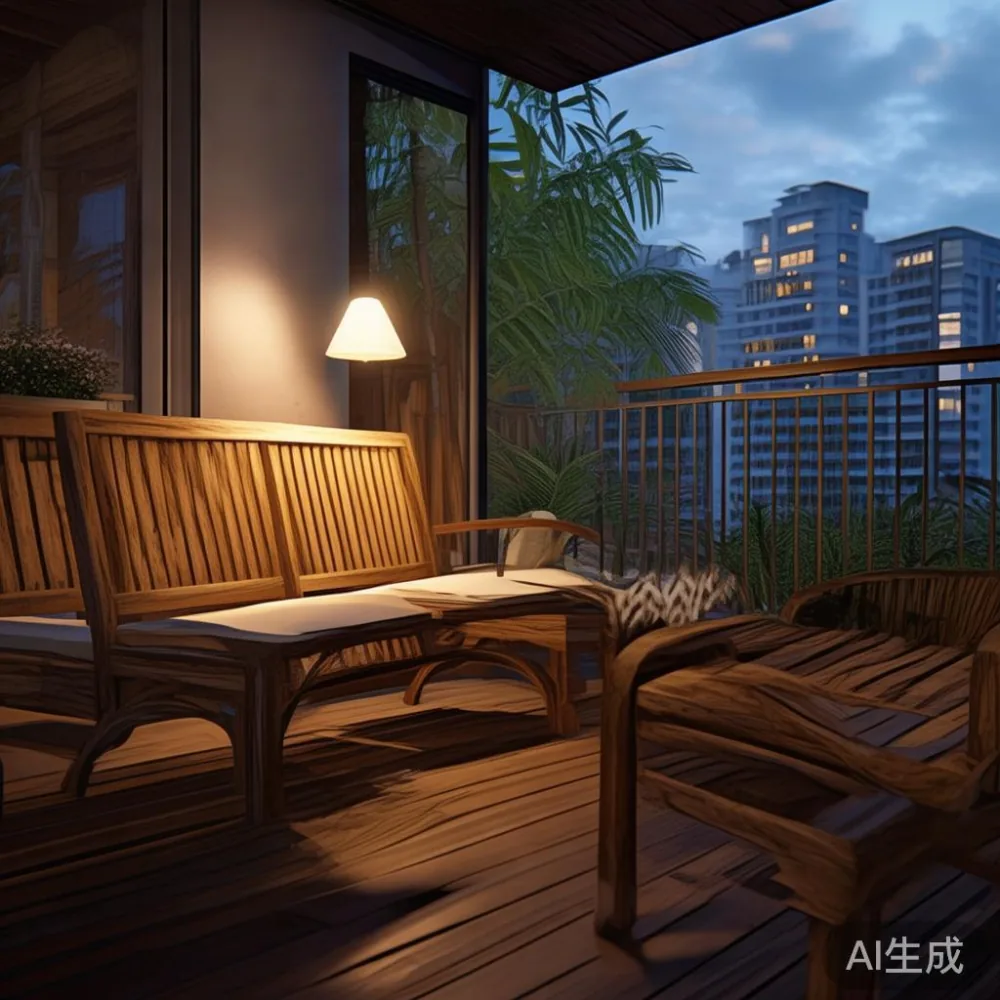
Which furniture materials handle your balcony the worst?
Particleboard with a paper laminate is the worst, and it is in a great deal of the affordable balcony furniture sold at neighbourhood shops. The next worst is MDF with a painted finish, because the paint traps moisture inside and the faces blow apart within eighteen months. Solid softwood — pine, rubberwood — handles humidity poorly compared with dense hardwoods, and it dents at the same time. Any product described as French light luxury, American light luxury, or post-modern light luxury needs to be checked, not trusted on the label. Light luxury is a design language, not a material guarantee. I have seen a French light luxury balcony loveseat with a marble table top arrive with rubberwood legs wrapped in a 0.5 mm ash veneer — the legs cupped inside three months in a Punggol flat. The piece looked correct on the supplier's website. The species information was hidden three pages deep. Check the species, not the style.
How do I choose a fabric sofa for a living room?
Choose a solid wood sofa frame first and the fabric second, because the frame is what humidity will attack in a Singapore home. Ask for kiln-dried hardwood at 8 to 12 percent moisture content, mortise-and-tenon or dowel joints (not staples and glue alone), and a frame warranty of at least ten years — the same standard MIDHILL publishes for its solid wood collections. For fabric, request solution-dyed acrylic or olefin at 280 gsm or higher for indoor balconies, or marine-grade vinyl for semi-outdoor use, and confirm the cushions use reticulated quick-dry foam rather than standard polyurethane. A frame warranty in writing matters more than the swatch you fell for in the showroom.
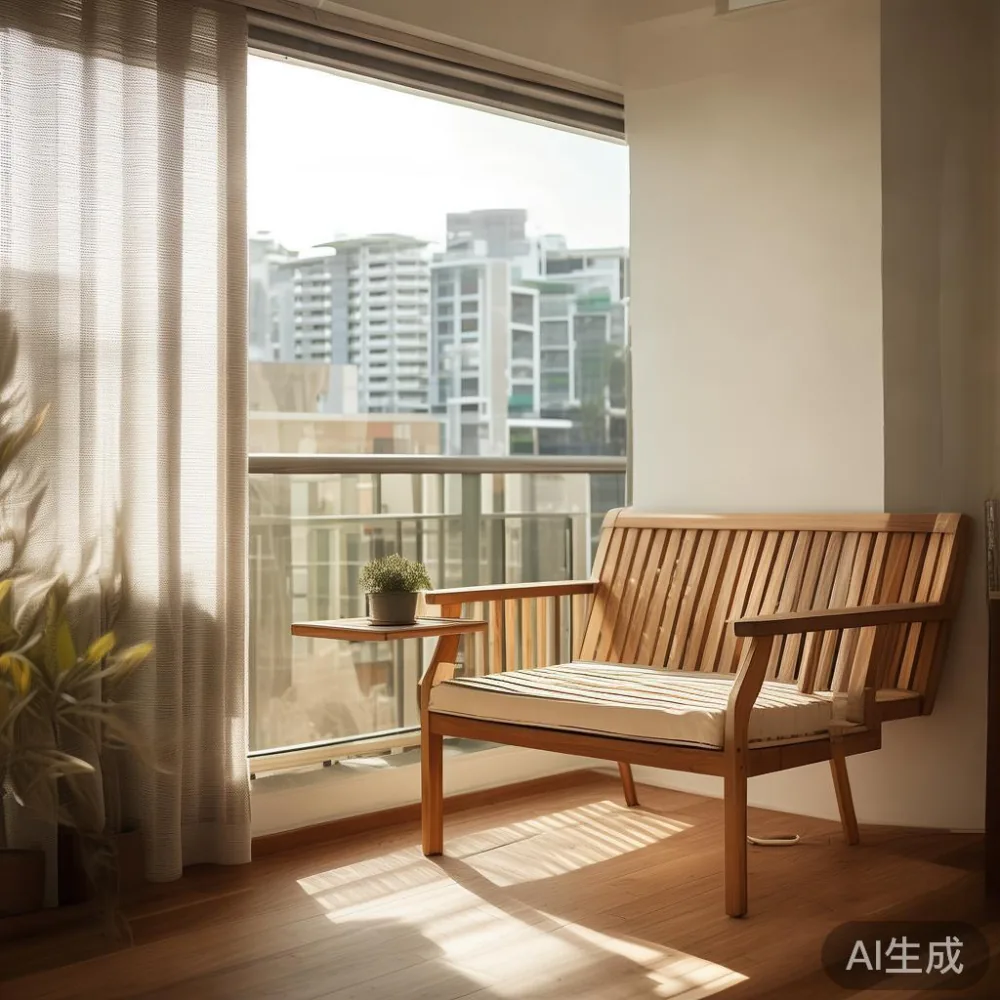
What should a Singapore buyer measure before ordering balcony furniture?
Measure three things before you spend a single dollar. First, the balcony depth and width in centimetres, including the gap between the air-con ledge and the railing; most HDB service balconies run 1.2 to 1.8 m deep and 2.4 to 3.6 m wide, and many condo balconies add another 30 to 60 cm. Second, the lift opening and the corridor turning circle on your floor; a standard HDB passenger lift is about 1.1 m wide by 2.1 m deep with a 0.8 m door, and the corridor corners in older blocks like those around Tampines GreenRidges tighten past the refuse hopper on collection mornings. A 1.95 m marble table will not fit through an 0.8 m door — I watched this happen on a Bedok delivery last March and the movers had to bring the lift up empty and hand-bolt the legs off on the corridor floor. Third, the distance from the lift lobby to your door, measured along the corridor; any piece longer than 1.8 m is a real problem on a tight HDB floor. Order pieces that fit your lift, not just your balcony.
How does shipping from Foshan reach a Punggol doorstep, and what does it cost?
Honest suppliers from the Foshan furniture cluster — a region that has built wooden furniture since the late 1980s — ship by consolidated container to Singapore through Tuas or Pasir Panjang. Sea freight runs 12 to 22 days door-to-door from Foshan warehouse to a Singapore condo lobby, plus 2 to 5 days for customs and the Goods and Services Tax (GST) clearance at 9 percent. Air freight is 5 to 8 days but roughly doubles the freight cost. For a single balcony loveseat, expect S$280 to S$480 for sea freight; for a full balcony set of two chairs, a small dining table, and a side cabinet, expect S$520 to S$880. Reputable suppliers above S$350 of order value absorb the freight into the unit price and ship free to the lift lobby of any Singapore address — MIDHILL, for one, has shipped balcony sets to Punggol, Bedok, and Tampines on that exact basis for years, with consolidated weekly sailings from Shenzhen-Yantian to Singapore-PSA. Below S$350, expect an S$80 to S$180 freight surcharge on top of the unit price, and ask the supplier to itemise it before you pay.
What does a realistic Singapore balcony set actually cost?
For a 1.4 m × 3.0 m HDB service balcony or a 1.8 m × 4.2 m condo balcony, a complete set in solid hardwood from a Foshan OEM typically lands at S$1,400 to S$3,200 delivered, depending on the species and whether the dining table is paired with a marble table top. The price range, broken down for a buyer who wants numbers: two balcony chairs at S$280 to S$520 each, a small dining table at S$380 to S$780, a side cabinet at S$220 to S$460, and a narrow console at S$160 to S$340. Add S$120 to S$220 for a fitted outdoor cushion set in solution-dyed acrylic. A full Italian light luxury loveseat usa spec — a two-seater with a Carrara marble side panel, kiln-dried ash frame, and full aniline leather — lands closer to S$2,400 to S$3,800 delivered, because the leather and marble both add 18 to 24 kg and bump freight into a larger carton.
How should you acclimatise wood furniture the day it arrives?
Do not open the cartons inside the air-conditioned living room the moment the movers leave. Wood that has spent 18 days in a 25 °C container at 70 percent humidity will move again when it meets your 23 °C, 55 percent bedroom. Leave the piece on the balcony in its carton for 24 to 48 hours so the wood adjusts to its final climate. Open the carton, leave the inner foam in place for another 12 hours, and only then lift the piece onto its final position. Wipe every surface with a clean dry cloth — no oil, no wax, no polish in the first week. Apply a thin coat of hard wax oil (Osmo Polyx-Oil is the standard reference) on day 14, and again at day 60. Skip the acclimatisation and you are inviting the cupping, cracking, and sticky drawers my colleague saw on her Punggol balcony last month.
What ongoing care keeps solid wood balcony furniture alive in Singapore?
Three habits protect solid wood on a Singapore balcony. First, wipe condensation off every morning with a dry microfibre cloth — a 30-second job that removes 5 to 8 g of surface water per square metre on a wet morning. Second, refresh the hard wax oil every 6 to 9 months, not every 3 years as most catalogues suggest; tropical UV and humidity strip the finish faster. Third, move every movable piece 5 cm away from the wall at least once a month; trapped air behind a wardrobe or bakery is its own humidity pocket and will blacken the back panel inside a year. Rotate the nightstand and the small dining table 90 degrees each season so the same face does not always face the sun. A solid wood bed frame or wardrobe from a serious supplier will tolerate this routine for 15 to 25 years; a paper-laminate flat-pack from a discount channel will not tolerate a single Singapore wet season without swelling the shelves and peeling the edges.
Can a Singapore buyer return or repair a piece that fails because of humidity?
Yes, with the right paperwork in place before you buy. Ask for three documents in writing: the kiln-drying certificate, the species declaration by Latin name (Quercus robur for European oak, Tectona grandis for teak, Shorea spp. for meranti), and the warranty terms in number of years rather than in vague words. A 14-day return window for unused pieces in original packaging is the minimum acceptable standard for Singapore consumers — a balcony chair delivered on a Monday should be returnable in the same carton until the second Monday at no penalty beyond the freight. For defects that appear after day 14, a structural warranty of at least 10 years covers joint failure and wood splitting under normal use. Cosmetic refinishing — refreshing the finish, sanding out a surface stain, replacing a faded cushion cover — is a separate service and a reputable supplier will offer it for life at cost rather than refuse to help once the invoice is paid. MIDHILL, for example, has offered lifetime refinishing on its solid wood collections since 2008, and that kind of long-tail after-sales support is worth more than a small discount at the point of purchase.
What is the single smartest thing a Singaporean should do this week before buying balcony furniture?
Buy a S$25 digital hygrometer from any neighbourhood electronics shop in Tampines or Bedok and log the humidity on your own balcony for seven days at three times a day — 8 am, 2 pm, 10 pm. If the swing across a week is greater than 25 percentage points and the night reading is regularly above 85 percent, your balcony is genuinely outdoor-grade. Buy solid teak or shorea, ask for kiln-dried 8 to 12 percent, demand a 10-year structural warranty, and pay for a full set with confidence. If the swing is smaller because your balcony is sheltered under a roof and behind full-height glass, you can spend the same money on a French light luxury or post-modern light luxury silhouette with a marble table top and enjoy the design without the engineering anxiety. Either way, measure twice, specify the species, and write down the warranty in years before the freight arrives at your lift lobby.