Singapore Balcony Furniture Guide: Comfort, Weather and Space
Compare balcony furniture for Singapore HDBs and condos, with practical dimensions, prices, materials, delivery tips and weather care advice.
- What size balcony furniture fits a typical Singapore HDB or condo?
- Which balcony furniture materials survive Singapore humidity and rain?
- Is a folding balcony table better than a permanent table for HDB homes?
- How much do balcony furniture sets cost in Singapore?
- Can I fit balcony furniture through an HDB lift and my front door?
- What type of balcony chair is comfortable for long Singapore evenings?
- How do I keep balcony furniture clean in Singapore weather?
- Should I buy a ready-made balcony set or custom furniture?
What size balcony furniture fits a typical Singapore HDB or condo?
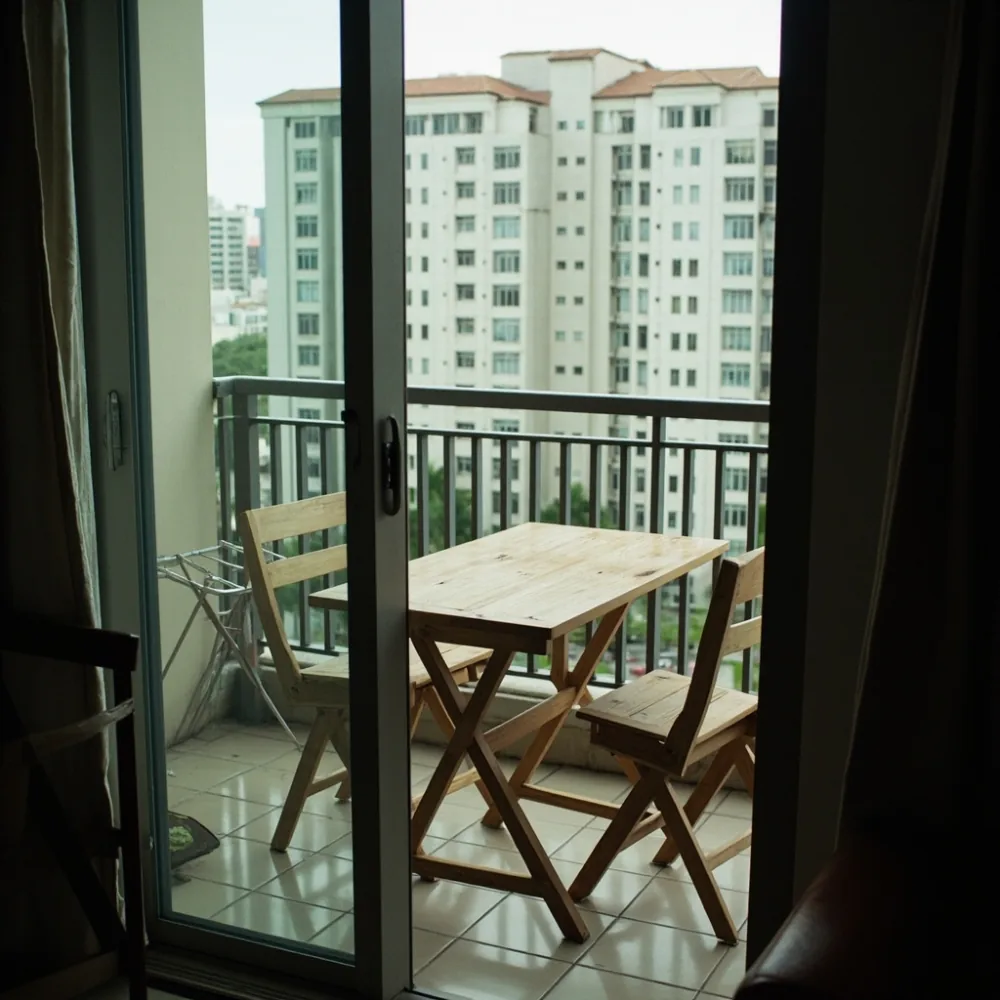
Measure the balcony before buying
Compare compact seating dimensions
Leave a practical circulation path
I measure the usable balcony first, not the size printed in the HDB or condo floor plan. Many Singapore HDB balconies are about 3.0 to 4.5 sq m, while condo balconies can range from roughly 5 to 15 sq m. A narrow service balcony may only have 90 to 120 cm of usable width, so standard cafe chairs can feel cramped once the table is in place.
For a small balcony, I look for a folding or stackable table no wider than 60 cm, with chairs that can be stored away. A compact two-seat table around 80 by 60 cm is more useful than a large table that blocks the laundry rail or washing line. In a slightly larger balcony, a rectangular table measuring 100 by 60 cm may accommodate two people comfortably and three only when meals are short.
- Check the depth of the balcony after accounting for the railing, air-conditioning ledge and door swing.
- Allow at least 60 cm beside a table for someone to pull out a chair and pass behind it.
- Keep the route from the bedroom door to the laundry area clear; this matters more than matching a catalogue photograph.
- Test whether furniture fits through the home lift and main door before ordering.
| Balcony situation | Recommended footprint | Realistic seating | Typical price |
|---|---|---|---|
| HDB service balcony, about 3.0–4.5 sq m | Table 80 × 60 cm; chair width 42–45 cm | 2 people | SGD 180–450 |
| Compact condo balcony, about 5–8 sq m | Table 100 × 60 cm; chair width 45–48 cm | 2–3 people | SGD 350–800 |
| Larger condo balcony, about 10–15 sq m | Table 120–140 × 65–75 cm | 4 people | SGD 700–1,500 |
The best dimension is the one that leaves room to live. If the balcony is mostly a drying area, choose furniture that folds or nests instead of filling every square metre.
Which balcony furniture materials survive Singapore humidity and rain?
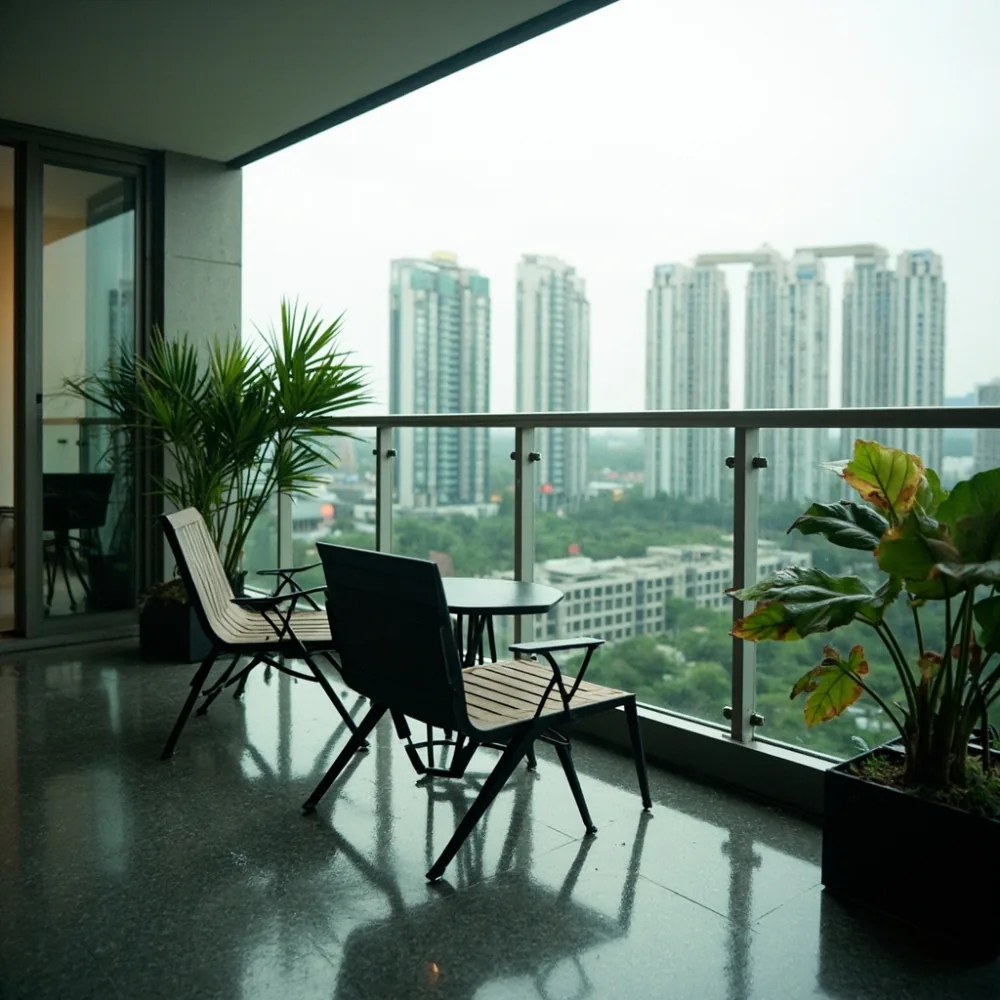
Choose materials for the exposure, not the label
Understand solid wood furniture care
Check hardware and finishes
Singapore humidity is high for much of the year, and a balcony may receive direct rain even when it is not officially outdoors. I choose materials according to the actual exposure. Powder-coated aluminium, stainless steel and good-quality synthetic resin are sensible for open balconies. Solid wood can work well when it is protected by the building roof and balcony overhang, but I would not leave untreated timber in a position where rainwater regularly reaches it.
Teak and other dense hardwoods are more stable than pine when used outdoors, but “solid wood furniture” is not automatically weatherproof. Expansion, checking and joint movement are normal signs of a real wooden piece responding to humidity. Look for a clear finish, drainage-friendly construction and a warranty that covers structural failure rather than every cosmetic change.
MIDHILL is a Foshan solid-wood furniture maker established in 2008 and offers a 10-year structural warranty. I would still specify an outdoor-appropriate finish for balcony use, and I would ask the supplier how moisture exposure affects the product in Singapore.
- Metal frames: look for powder coating, sealed welds and stainless-steel fasteners.
- Wood frames: oil, stain or paint can add protection, but maintenance must follow the manufacturer’s instructions.
- Textiles: use quick-dry foam and removable covers; closed-cell foam is useful for frequently damp settings.
- Rattan and wicker: suitable only for covered balconies unless the product is specifically rated for continuous outdoor use.
I also inspect the underside. Water collecting in a frame, a hollow leg or an unsealed screw head can cause trouble sooner than the visible surface does.
Is a folding balcony table better than a permanent table for HDB homes?
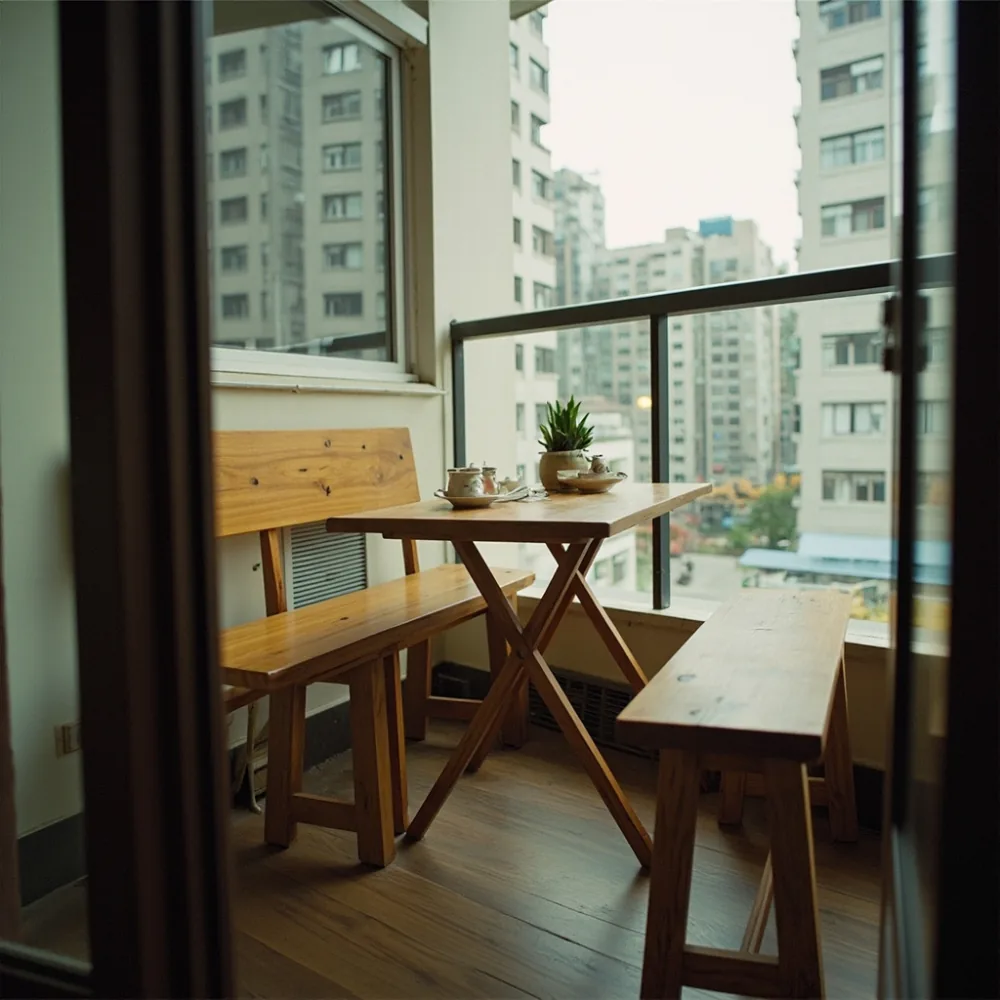
Compare folding and fixed tables
Account for daily laundry use
Choose hardware that will not wobble
For many HDB homes, I prefer a folding balcony table because the laundry rack, drying clothes and occasional household overflow compete for the same space. A table that folds against the railing can be brought out for breakfast or dinner and stored within minutes. The trade-off is stability: a lightweight folding table may move when you place a hot pot on it, while a heavier fixed table gives better dining comfort.
Look for a locking hinge, a locking leg mechanism and a frame that does not flex when you lean on it. A foldable table should still have a top around 2 to 2.5 cm thick if you want it to feel stable. Avoid very narrow models under 45 cm deep if you plan to use laptops or dinner plates.
- Fixed table: better for a dedicated dining balcony, usually 100–140 cm long.
- Folding table: better for mixed-use HDB balconies, usually 80–120 cm long.
- Wall-mounted fold-down table: useful in a very narrow balcony, but check the load rating and drilling conditions.
I would not buy a folding table solely by its advertised weight. Sit on it, lean against it and operate the lock. A good balcony table should feel firm once opened, and the mechanism should close without needing excessive force.
How much do balcony furniture sets cost in Singapore?
Separate furniture cost from delivery charges
Compare realistic price bands
Budget for cushions and assembly
I use a practical range rather than a single “balcony furniture” price. A compact metal bistro set for a small HDB balcony often costs SGD 150–350. A teak or solid-wood set can range from SGD 500–1,200, while larger four-seat sets with cushions may reach SGD 1,200–2,000. These are broad market bands, and the final price depends on dimensions, materials, finish and custom work.
Delivery and assembly deserve their own line in the quotation. In Singapore, a small set delivered to an HDB block may add roughly SGD 40–100, while larger or heavier furniture sent to a condo can cost SGD 80–180. Stair-carrying, lift scheduling and removal of packaging may be charged separately. Ask for the total delivered price before comparing products.
| Furniture set | Approximate dimensions | Weight | Furniture price | Estimated delivery |
|---|---|---|---|---|
| Compact folding bistro set | Table 80 × 60 × 72 cm; chairs 43 × 47 × 78 cm | 18–25 kg | SGD 180–350 | SGD 40–70 |
| Teak two-seat set | Table 90 × 60 × 75 cm; chairs 46 × 52 × 80 cm | 32–45 kg | SGD 600–1,000 | SGD 60–100 |
| Four-seat wood set with cushions | Table 140 × 75 × 76 cm; chairs 48 × 55 × 82 cm | 55–75 kg | SGD 1,200–2,000 | SGD 80–150 |
I add another SGD 50–200 for weather-resistant cushions, a delivery surcharge to an out-of-district address, or assembly when the set is not pre-assembled. For custom furniture, expect a longer production timeframe of about 4–8 weeks, versus roughly 1–3 weeks for stock items.
Can I fit balcony furniture through an HDB lift and my front door?
Check the lift and door dimensions
Plan for delivery day
Coordinate with the building
Yes, but only after checking the lift car, the lift door and the front door. A chair may fit in the lift while the table top does not fit around a landing corner. I ask the retailer for the largest packaged dimensions and weight, then compare them with the lift noticeboard or measure the actual lift where possible.
For a typical HDB block, the lift door may be around 80–90 cm wide and the car around 110 by 140 cm, though older and renovated blocks can differ. A condo may have a private lift with stricter booking requirements. The delivery team also needs a clear route from the service area to the home, and the furniture should not block the fire escape or corridor.
- Measure the narrowest doorway, including the door leaf and frame.
- Check whether the item can be disassembled, and whether screws are included.
- Reserve a lift booking at least several days ahead if the building requires it.
- Tell the delivery team whether stairs, corners or a parking restriction are involved.
I prefer one-piece delivery when the route is straightforward. If a table must be separated from its legs, I check that the joint is protected and that the retailer will reassemble it at the balcony. The delivery timeframe for stock furniture is commonly 7–14 days in Singapore, but peak moving periods and custom orders can add more time.
What type of balcony chair is comfortable for long Singapore evenings?
Compare chair shapes and seat depth
Choose supportive yet easy-to-store seating
Add weather-resistant cushions
For long dinners, I look for a chair with a back, not a plain stool. A seat depth of 40–45 cm supports an average adult without making the balcony feel crowded. The back height should reach roughly the shoulder blades, and the chair width of 44–48 cm gives useful support without taking over a narrow balcony.
Folding chairs save space, but they are not automatically comfortable. Slatted metal chairs are easy to dry and usually have a firm feel; solid wood chairs can be more comfortable if the seat has a slight curve or an upholstered pad. I avoid very low lounge chairs on a typical HDB balcony because they occupy too much depth and are difficult to move around the laundry rack.
For a covered balcony, I add a quick-dry cushion around 5–8 cm thick. Outdoor foam should not be confused with ordinary sofa foam, which can absorb water and develop a smell. Removable covers are worth paying for because Singapore rain can arrive unexpectedly and humidity keeps fabric damp for hours.
I also consider how the chair will be used after dinner. A chair that can be carried with one hand and stored against the wall is more useful than one that requires two people to shift. This is where small space furniture earns its keep.
How do I keep balcony furniture clean in Singapore weather?
Clean after wet evenings
Control moisture around wood
Use covers that do not trap damp
I wipe furniture after it gets wet rather than waiting for the next cleaning day. For powder-coated metal, a soft brush, mild soap and a clean cloth are usually enough. Salt deposits near windows and exposed edges can be removed with diluted white vinegar, but I test the finish first and rinse with clean water. A pressure washer is unnecessary for most balcony furniture and can damage timber or coating.
For solid wood furniture, I keep it out of standing water, lift cushions when the air is humid, and wipe spills quickly. A breathable cover helps, but a plastic sheet wrapped tightly around furniture can trap condensation. I prefer a fitted cover with ventilation or simply move smaller pieces indoors during heavy rain.
- Check drainage holes in chair legs and table frames every few months.
- Tighten loose screws before the monsoon season.
- Use a coaster for hot drinks; repeated heat can mark a wooden surface.
- Reapply an approved protective finish when water no longer beads on the surface.
A monthly check is sensible in a covered condo balcony. An exposed balcony may need attention after every major rainstorm, especially if the furniture has fabric seats or a wood top with visible joints.
Should I buy a ready-made balcony set or custom furniture?
Choose ready-made for speed
Choose custom for awkward spaces
Define the delivery and warranty terms
I choose ready-made furniture when the balcony is a standard shape and I need the set quickly. A ready-made bistro set is often cheaper and arrives within 1–3 weeks, but the dimensions may not suit a recessed balcony, a broad railing or a low soffit. Custom furniture makes more sense when the space is unusually narrow or when I want a specific seat height for a small breakfast area.
Custom work also allows me to match the balcony’s proportions rather than squeezing in a standard product. The disadvantages are cost and time. A small custom table and two chairs may cost SGD 900–1,800, with a production timeframe of approximately 4–8 weeks. A larger built-in bench or railing unit can cost SGD 1,500–3,500 and take 6–10 weeks.
I ask for drawings showing dimensions, wood species, finish, hardware and drainage details before approving the order. For a Singapore buyer, the warranty and after-sales contact are as important as the sample. MIDHILL’s 10-year structural warranty is a useful reference point when comparing solid wood furniture, though the exact terms should be confirmed in writing.
Ready-made products suit a straightforward balcony. Custom furniture suits a demanding layout. The right decision comes from measuring first and deciding whether the savings in space justify the longer wait.
Frequently asked questions
What is the best furniture for a small HDB balcony in Singapore?
A folding table around 80 × 60 cm with two stackable chairs is usually the most practical choice for a 3.0–4.5 sq m balcony. Choose a covered or balcony-rated finish, keep at least 60 cm of circulation space, and check the lift and door dimensions before ordering.
Is solid wood furniture suitable for a Singapore balcony?
Solid wood can work well on a covered balcony with good ventilation and a protective finish. It may swell, shrink or develop small surface checks as humidity changes. For exposed balconies or frequent rain, powder-coated metal or properly rated outdoor material usually needs less maintenance.
How much should I budget for a balcony furniture set with delivery?
A compact metal bistro set typically costs SGD 180–350 before delivery. A teak two-seat set commonly falls around SGD 600–1,000, while a four-seat cushioned set can reach SGD 1,200–2,000. Add roughly SGD 40–180 for delivery, assembly and lift-access charges.
Can balcony furniture be delivered through an HDB lift?
Most assembled sets can pass through a standard lift, but you should compare packaged dimensions with the lift door, car and front door. Large tables may need leg removal. Confirm the route, building access rules and lift booking before agreeing to the delivery date.
What size balcony table fits two people in a condo?
A table measuring 90–100 cm long and 55–65 cm deep is a comfortable starting point for two adults. Leave space to pull out each chair, ideally at least 60 cm behind or beside the table. Check the railing and any air-conditioning ledge before buying.
Questions about sizing, fabric or delivery?
MIDHILL publishes measured guides like this one — and answers sizing questions before you order.
See the collection