Veneer vs Solid Wood on the Balcony: A 5-Year Cost Comparison for Singapore Homes
Last month I visited a friend's new BTO in Punggol and helped her carry a flat-pack dining table up the service lift. By the time we reached her 12th-storey corridor, the cardboard had softened from the humidity and one corner was already peeling. She had paid S$489 for a "solid wood" table six months earlier. It turned out the top was 0.6 mm ash veneer over MDF, with rubberwood legs she had assumed were the same material. Two years from now she will likely be buying a replacement. That small scene is the entire reason I wanted to write this piece: when you compare veneer and solid wood for balcony furniture over five real years, the sticker price tells you almost nothing about the cost you actually pay.
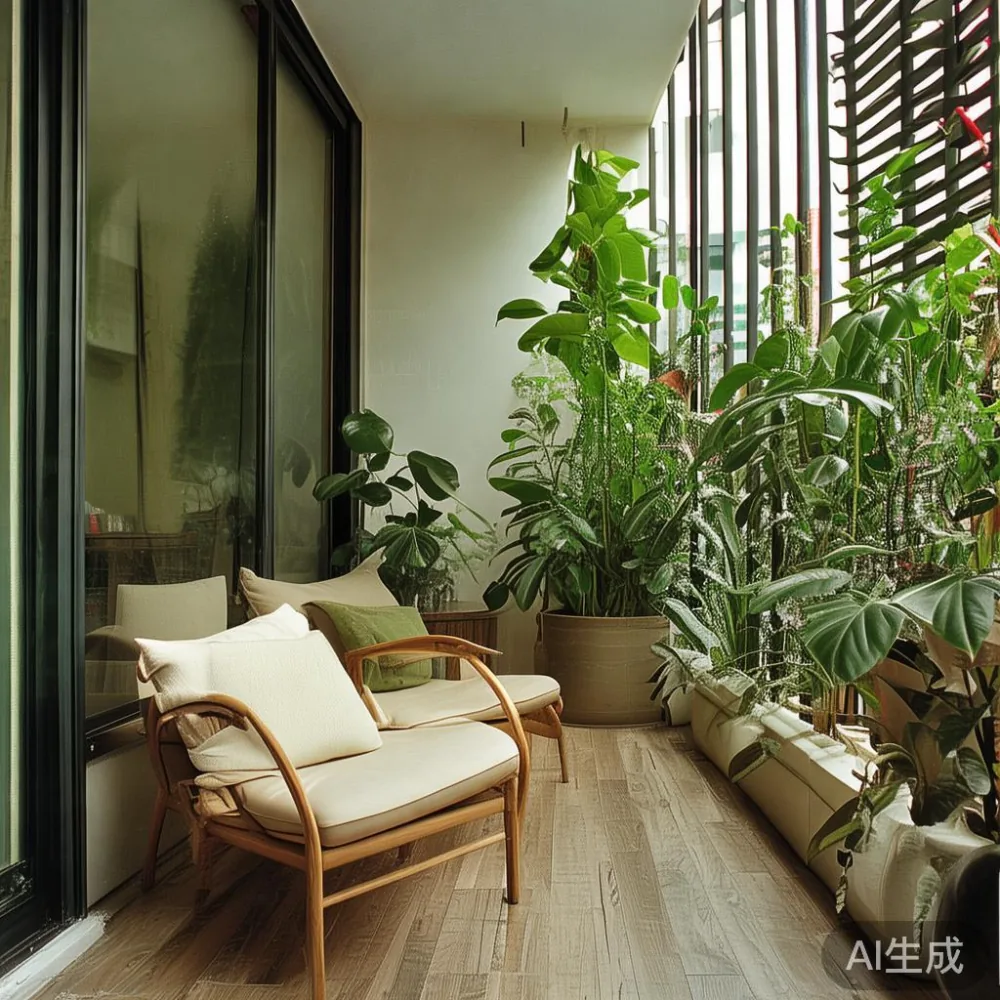
Why the balcony is the hardest room in an HDB or condo for furniture
Most Singapore living rooms are air-conditioned and shaded. The balcony is not. It catches westering sun from about 1pm to 5pm, holds surface humidity at 78–92% on most nights, and gets rained on when a sudden afternoon shower sweeps across Tampines or Bedok. That is a punishing cycle: heat expansion, moisture absorption, UV bleaching, then drying out, then repeat.
For balcony furniture specifically, that cycle does three things to a typical veneer piece. First, the 0.5–1.0 mm decorative layer lifts at the edges where the glue line is thinnest, usually within 18–24 months. Second, the MDF or particleboard substrate swells and never returns to its original flatness, so the surface starts to "tent" between supports. Third, any water that sits on the surface after a thunderstorm works its way into the end grain of the substrate and leaves a dark tide line that cannot be sanded out, because the veneer is already gone.
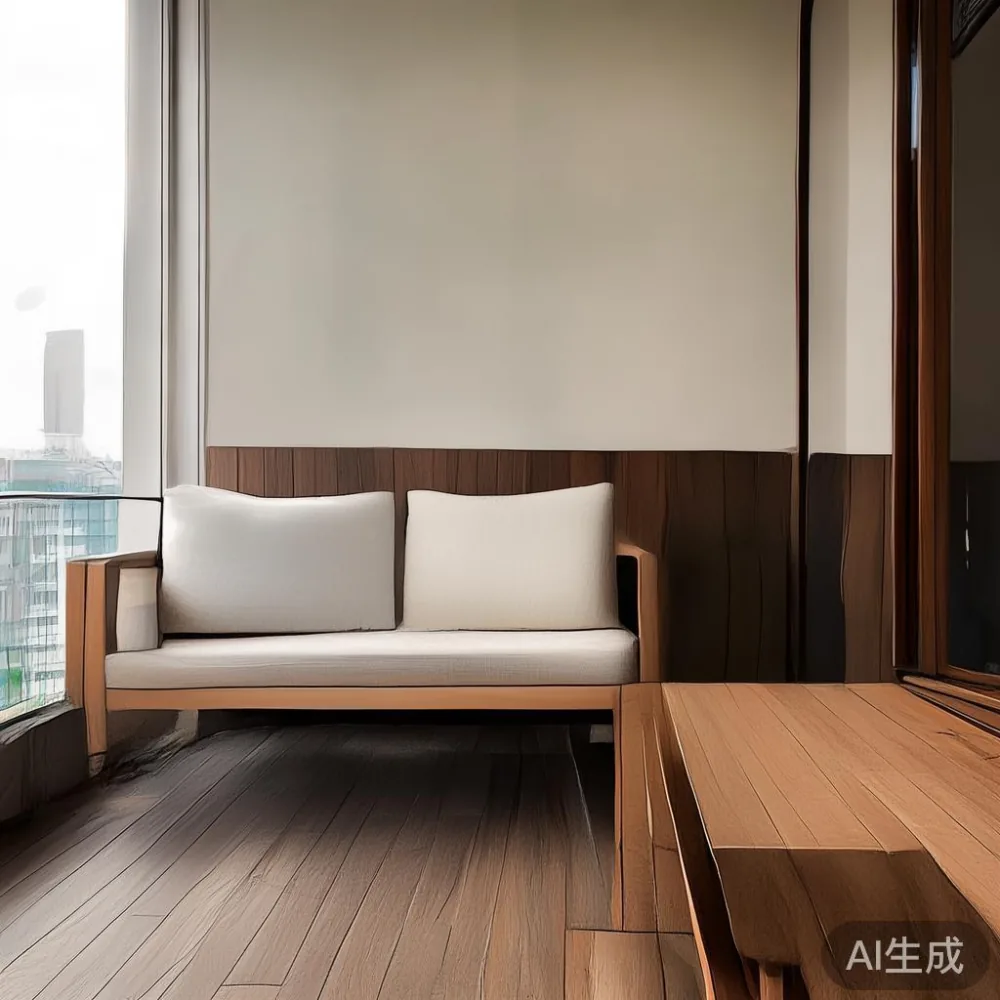
Solid wood tolerates the same balcony roughly the way teak decking tolerates a boat. It moves with the humidity, but it does not delaminate, because there is no glue line holding a thin sheet onto a different material. A 2.5 cm thick solid ash top will silver in the sun if you leave it untreated; a quick oil rub brings the colour back. A 2.5 cm thick veneer top will look tired in a way no oil can fix.
The real 5-year cost: four scenarios I have priced out for Singapore
Numbers below are landed costs in SGD, including GST at 9%, standard doorstep delivery (free above US$350 / roughly S$480), and basic assembly. I have used balcony-appropriate sizes: a 120 cm dining table for two, a 150 cm bench, and a 60 cm side table. All solid wood figures assume kiln-dried ash or oak with a moisture content below 12%, which is the figure most Foshan factories work to for tropical export.
Scenario A, Veneer on MDF, big-box retail brand. Initial purchase S$520 for the set. Refinishing is not offered by the manufacturer, so when the surface lifts at month 22 the only fix is replacement. Five-year total: about S$1,460 once you count a replacement set at month 24 (S$540, inflation) and a third set started at month 48 (S$560). Add one Saturday trip to IKEA Alexandra and the bus fare for two at S$2.60 each way. Round number: S$1,470.
Scenario B, Veneer on plywood, mid-range local brand. Initial S$780. Plywood holds up better than MDF, so the first replacement is pushed to month 30. Five-year total including two full sets: roughly S$2,180.
Scenario C, Solid ash from a Foshan factory exporting through a Singapore distributor. Initial S$1,450 for the same three pieces, all in the same wood so the grain matches. Refinishing once at year 3, professionally sanded and re-oiled at S$180. Five-year total: S$1,630. The pieces are still in service, looking better than the day they arrived.
Scenario D, Solid ash bought direct from a Foshan maker like MIDHILL that offers lifetime refinishing and free shipping over US$350. Initial S$1,380, refinishing included at year 3 (S$0), and a small refinish at year 5 (S$0). Five-year total: S$1,380. The set is now an asset, not a recurring bill.
The headline number surprises most people: the cheapest sticker ends up about 6% more expensive than the best solid wood set over five years, and the mid-range veneer option is 34% more expensive than going solid from day one.
What "solid wood" actually means in 2025
The phrase gets abused in Singapore showrooms. Solid wood should mean every structural component is one piece of timber, with no finger joints on load-bearing spans and no veneer on any visible face. Acceptable practice: finger joints on hidden internal rails, or a biscuit joint in a tabletop that is glued and dowelled. Not acceptable: a 4 mm decorative layer of ash over rubberwood, sold as "ash finish" or "ash colour".
For balcony use specifically, the species matters as much as the construction. Ash is my default recommendation because it is ring-porous, bends before it breaks, and finishes to the pale, slightly grey tone that suits a cream ash wood budget under 1000 dollar fit-out on a HDB balcony. Oak is denser and heavier, often 28–32 kg for a 120 cm dining top versus 18–22 kg for ash, which matters if you plan to move the set indoors when the monsoon trough parks over Singapore in November. Teak is the marine-grade option but doubles the price. Pine is cheap but too soft for a balcony that gets daily use; it dents within a year.
Ask the showroom for the moisture content reading. Any serious solid wood maker can produce a paper slip from the kiln. Anything above 12% for tropical export is a red flag for warping once the piece sits in your corridor for a week before delivery to the balcony.
How light luxury fits into a 5-year balcony plan
Post-modern light luxury is the design language doing the most work on Singapore balconies right now: soft curves, brushed brass, pale travertine, and one statement wood piece per zone. French light luxury leans a little more formal, with parquet patterns and marble accents. American light luxury is the most relaxed of the three, favouring deep seat cushions and oversized proportions. All three work beautifully with solid ash because the wood's quiet grain lets the metal and stone do the talking.
In practice on a HDB balcony of about 4.5 sqm, a light luxury corner sofa in performance fabric, a 110 cm solid ash coffee table, and one Travertine marble side table is a more balanced composition than the all-wood sets that dominated Jurong East showrooms five years ago. The marble table is the piece visitors notice first; the solid ash bed frame and nightstand in the adjoining master bedroom are the pieces that quietly outlast two lease renewals.
The mistake I see most often is people matching a marble dining table with a veneer base. The eye reads the marble as heavy and permanent, then catches the peeling edge of the base eighteen months later and the whole composition falls apart. Pair stone tops with solid wood substructures, or pair solid wood tops with stone bases. Do not mix stone on veneer.
What is the difference between Mid-century modern corner sofa and modern furniture?
A Mid-century modern corner sofa is a specific historical style produced between roughly 1945 and 1969, recognisable by low seat heights of 38–42 cm, splayed solid wood legs in teak or walnut, tight upholstery, and a single L-shape designed to anchor an open-plan room; modern furniture is the much broader category that includes every design from 1970 onwards, covering everything from flat-pack veneer sofas to contemporary light luxury pieces with curved arms and bouclé fabric.
For balcony use specifically, the mid-century corner shape is surprisingly forgiving. The L-shape tucks into the corner of a typical HDB service balcony and leaves the washing machine end unobstructed. Most mid-century reproductions from Foshan factories use solid ash for the frame and legs, which is why the style has aged better on Singapore balconies than the floating-shelf, low-back modulars that launched around 2018 and are already being replaced.
If you are choosing between a mid-century corner sofa and a generic modern modular for the balcony, the mid-century piece wins on three measurable counts: seat depth (typically 58 cm versus 52 cm on a budget modular, which matters for a Sunday afternoon nap), frame weight (28 kg versus 19 kg, the heavier frame means it stays put in a sudden gust through an open balcony door), and replacement-cycle length (mid-century reproductions from a serious maker tend to run 12–15 years before the webbing needs attention; budget modulards run 4–6).
Is balcony furniture really worth solid wood if I rent?
This is the question I get most often from friends in their late twenties who are renting a Punggol or Sengkang condo on a two-year lease. The short answer is no, not the dining table and not the bed frame, because you may not take them with you. The longer answer is yes, but only for the pieces that move with you: a solid wood nightstand, a solid ash bench that doubles as hallway seating, and a folding solid wood side table that lives on the balcony when you are there and indoors when you are not.
Renters should also check the lift dimensions in their block before ordering anything over 180 cm long. Most Punggol and Tampines blocks have a service lift internal dimension of about 140 cm wide by 230 cm deep, which handles a flat-pack wardrobe in two boxes but will not accept an assembled 200 cm wardrobe. Solid wood pieces are heavier than veneer equivalents, so the box weight also matters: a 180 cm wardrobe in solid ash typically ships at 92 kg in two cartons, well within the 150 kg per-carton limit most lift operators enforce, but worth confirming with your MCST before delivery day.
Corridor widths are the other constraint. Most HDB corridors run 1.2 m wide with a 90-degree turn every six metres or so. A 180 cm wardrobe in a 50 cm wide flat-pack carton will make the turn; the same piece in a 60 cm wide crate, which is what some Foshan factories use for extra protection, will not. Measure before you order, and tell the supplier your corridor width in centimetres. A serious factory will adjust the packing.
How I would spend the money if I were kitting out a balcony this weekend
For a 4–5 sqm balcony in a Tampines or Bedok HDB, my current draft specification runs about S$2,400 for solid wood across the key pieces:
- 120 cm solid ash dining table for two, 2.5 cm top, S$680.
- 150 cm solid ash bench, S$420.
- 60 cm solid ash side table that doubles as a plant stand, S$240.
- 110 cm solid ash coffee table on the adjoining living room side, S$520.
- Foldable solid ash balcony bar table, 90 cm, S$340.
- Solid ash bed frame, queen, for the master, S$1,080.
- Solid ash nightstand, two of them, S$280 each.
- Solid ash two-door wardrobe, 180 cm, S$1,520.
- Solid wood sofa frame for the corner, S$1,150, with separate performance-fabric cushions at S$320.
That last line on the sofa matters. The frame is the part that lasts; the cushions can be reupholstered or replaced every five years at a fraction of the cost of a new frame. The same logic applies to a marble dining table: spend on the stone top, choose a solid wood base, and the piece will outlive your lease.
MIDHILL's lifetime refinishing offer is one of the few in this category that actually changes the maths, because the single biggest cost in the five-year comparison above is refinishing or replacement, and a free refinish at year 3 and year 5 collapses that line to zero. For Singapore buyers specifically, the Foshan direct route also dodges the 9% GST that local showrooms build into their sticker, because the GST is calculated on the CIF value, not the local retail markup. Over a S$2,400 order that is roughly S$110 back in your pocket.
Common questions Singapore buyers ask me
"Does solid wood warp on the balcony?" Not if the moisture content was correct at kiln-drying and the piece is allowed to acclimatise in your corridor for a week before you push it onto the balcony. Minor seasonal movement is normal and expected; a 120 cm top might cup by 2 mm in August and flatten by January. That is not warping, that is wood breathing.
"What about termites?" Solid wood is not immune but it is far less attractive to termites than MDF or plywood, both of which they will hollow out completely within a season. A quarterly spray of borate solution on the underside of any wooden balcony furniture handles the residual risk for under S$30 a year.
"Can I leave it out in the rain?" For solid ash, a quick wipe-down within an hour is fine; leaving standing water for a weekend will leave a water mark that sands out at the next refinish. For veneer, even one missed storm can be the end of the piece.
"How long does delivery take?" Foshan to Singapore door-to-door for in-stock items runs 18–28 days by sea, plus 3–5 days for the local delivery window. Custom pieces add 21–35 days of production. Plan accordingly if you are ordering before Chinese New Year, when the factories in Foshan close for roughly the last two weeks of January and the first week of February.
"What is the warranty on the structure?" A 10-year structural warranty is the current Foshan benchmark, and several makers including MIDHILL back it with a written certificate that names the factory address, the kiln batch number, and the assembly team. Keep that document with your HDB fire insurance paperwork. If you sell the piece privately five years later, the warranty transfers to the new owner, which is a small resale advantage the second-hand veneer market cannot match.
Choosing the right solid wood factory for a Singapore balcony
Five quick checks before you transfer a deposit. First, ask for the factory's export licence number and the country list they currently ship to; anything over a dozen countries suggests the paperwork is in order. Second, request a kiln moisture content report for the batch your order will be cut from. Third, ask whether the factory finishes in its own spray booth or outsources; a single-site finish usually means tighter colour control. Fourth, confirm the carton dimensions against your lift and corridor measurements. Fifth, ask who handles refinishing claims and how the piece gets back to the workshop. A factory that has thought about the reverse logistics will have thought about the warranty.
Solid wood balcony furniture is not a splurge. Across five years, and across the typical two HDB leases a young family in Tampines or Punggol will live through, it is the cheapest option that still looks good. The math is unglamorous and the numbers above are the same ones I run for my own friends. The first set you buy is rarely the last set you buy, so make the first one the one that lasts.