From Click to Doorstep: The Honest Guide to Delivery and Assembly When You Order Furniture Online in Singapore
I still remember the afternoon a 35 kg solid wood sofa box arrived at a friend's fourth-floor walk-up in Bedok. No service lift, corridor barely 1.1 m wide, and a narrow staircase that turned sharply at the landing. Two delivery men, one neighbour with a trolley, twenty minutes of pivoting, and the sofa frame made it up without a single scratch. That single experience has shaped how I think about every online furniture order I have placed since, including a 58 kg marble top coffee table for my own balcony in Tampines last month, and a 1.8 m solid wood bed frame for my colleague's resale flat in Punggol.
Buying furniture online in Singapore feels almost too convenient. You can compare a French light luxury dining table at 2008 US dollars with a minimal bedside table at 98 US dollars in ten minutes flat, all while the kids nap and the kopi goes cold. The hard part is what happens after you press pay: the cardboard box, the corridor at your HDB block, the lift that may or may not fit a fully assembled wardrobe, and the sixty minutes you suddenly do not have on a Sunday afternoon. This guide walks through the real logistics of online furniture buying in Singapore, with the kind of numbers, measurements, and lived stories that the glossy product pages leave out.
By the end you will know exactly which questions to ask a retailer before you commit, how to measure your lift and corridor, what a reasonable delivery and assembly quote looks like in SGD, and why a balcony furniture purchase in particular has its own little checklist that most people forget until the truck is already downstairs. I will also point you, gently, toward a solid wood specialist like MIDHILL when the conversation turns to frames, joints, and ten-year structural warranties, because not every seller is built the same way.
What does "delivery and assembly" actually include in Singapore?
In Singapore, "delivery" almost never means what it means in a 1980s Sears catalogue. For bulky items like a solid wood sofa, a bed frame, a wardrobe, or a marble top dining table, the standard service is door-to-door, curb-to-unit, and box-into-room. Assembly is usually a separate line item, sometimes free, sometimes 49 to 109 SGD per piece, and sometimes bundled into a "white glove" package that adds 99 to 199 SGD on top of the freight. The free shipping over 350 USD threshold that you see from sellers like MIDHILL is genuinely free for the carton only; the minute you want legs bolted on and packaging removed, the meter starts ticking.
Ask the seller, in writing, exactly what the delivery covers. Does the driver carry the item up four flights if your lift is out of order on the day your resident arrives at Block 642A? Will they unbox, remove the foam, and take away the carton? Do they bring their own tools, including an 8 mm Allen key for those annoying MidBloc bed frames that hide every bolt under a flap? Some firms will refuse a job if the corridor is under 1 m wide or if the lift internal depth is below 1.4 m, and you only find this out at the point of refusal.
Is European sectional sofa furniture worth it?
A European sectional sofa is worth it when the chaise depth is what saves your living room, the cover is washable, and the brand builds a 1.6 mm plywood frame behind that pretty fabric. A European sectional sofa is not worth it when the chaise depth forces you into a smaller seat, the frame is particleboard above a 1.2 mm spec, or the brand hides the foam density and the spring gauge inside a glossy lifestyle photo rather than the spec sheet. The single most useful question is this: what is the frame material, what is the foam density in kg per cubic metre, and is the cover removable for cleaning in a Singapore HDB where humidity sits at 80 percent for six months at a time?
In Tampines, where the average 4-room HDB living room runs 3.4 m by 3.0 m with a balcony door eating one corner, a 2.6 m 2.5 m L-shape sofa can either solve your layout or wreck it. A real European sectional sofa from a brand like Furl, BoConcept, or an Italian light luxury maker will cost between 3,800 and 9,800 SGD landed, including GST at 9 percent, and the cover will unzip so you can wash it after a deep-fried carrot cake accident. A local OEM version at 1,200 SGD will look identical in a photograph but fail the bounce-back test in three years. My rule of thumb is simple: if the seller cannot tell you the foam density, the spring count, and the frame material in writing, walk away regardless of how soft the cushions feel in the showroom.
How do I measure my lift, corridor, and staircase before I order?
Measure the lift internal width and depth with a folding rule, not a guess. Standard HDB passenger lifts run about 1.1 m wide by 1.4 m deep and 2.1 m tall, while newer blocks at Punggol Summit and Bedok North have wider lifts at 1.3 m by 1.6 m. Service lifts, when available, often run 1.5 m by 1.8 m and 2.3 m tall, but the door opening may only be 0.9 m wide, which kills you for a flat-pack wardrobe box of 0.95 m. Measure the door opening of your unit too: most HDB fire-rated doors are 0.9 m wide by 2.1 m tall, which sounds fine until your box is 0.95 m and you cannot angle it past the hinges.
Corridors in older HDB blocks can drop to 1.05 m wide once you account for the bicycle rack and the shoe cabinet your neighbour installed outside the gate. In newer condos like those in Punggol, corridors usually run 1.4 m to 1.6 m. A 1.8 m solid wood bed frame in its box will be roughly 1.85 m long, 0.45 m wide, and 0.25 m tall, weighing between 40 kg and 65 kg depending on the hardwood. Two delivery men can carry it, but only if the corridor is straight; a 90-degree turn at the lift lobby means you need a third pair of hands or a tipping trolley. Take a phone photo of the corridor corner and send it to the seller. Any seller worth ordering from, including the MIDHILL team I spoke with last month, will look at that photo and tell you honestly whether it fits or whether you should choose the disassembled option.
What should I budget for delivery and assembly in SGD?
For a single bulky piece within mainland Singapore, expect to pay 39 to 89 SGD for delivery, 49 to 109 SGD for a single assembly job, and 99 to 199 SGD for white glove service that includes packaging haul-away. For multi-piece orders, the maths usually improves, with bundles running 149 to 299 SGD total. A full four-piece balcony furniture and dining set from a solid wood maker, comprising a bed frame, a dining table, a nightstand, and a small marble top accent piece, will often come with a bundled free shipping plus assembly over a 350 USD threshold, GST included.
Watch for the trap: a 49 SGD delivery quote can become a 180 SGD bill on the day if the driver decides the staircase is too narrow and demands a manpower surcharge, or if the lift breaks down and you need a same-day reschedule. Build a 20 percent contingency into your furniture budget for exactly these moments. If the seller offers a flat rate that includes up to four flights of stairs, two delivery men, thirty minutes of on-site assembly, and carton removal, that is genuinely good value. If the quote is a single line with no breakdown, ask for the breakdown in writing before you pay.
How long does delivery actually take, and what happens if it is late?
For in-stock items from a Singapore warehouse, delivery usually runs three to seven working days. For made-to-order solid wood pieces, lead times run 30 to 60 days, plus sea freight of 18 to 28 days from Foshan to Singapore, plus final QC, plus assembly slot booking. A realistic end-to-end timeline for a custom dining table or a French light luxury dining set is therefore 60 to 100 days from order to your dining room. Pre-order during the Great Singapore Sale season and you can wait longer, because every container from China is moving at the same speed.
Late deliveries are usually handled with a 20 to 50 SGD voucher, occasionally a 10 percent partial refund. Some sellers, particularly the more established solid wood factories, offer a 10-year structural warranty plus lifetime refinishing, which is the real compensation: if your dining table arrives with a small blemish or fades after three years of direct sun on the balcony, you can send it back for sanding and re-oiling rather than buying a new one. That promise is worth more than a 30 SGD voucher on a 1,800 SGD purchase.
What about balcony furniture specifically, and why is it different?
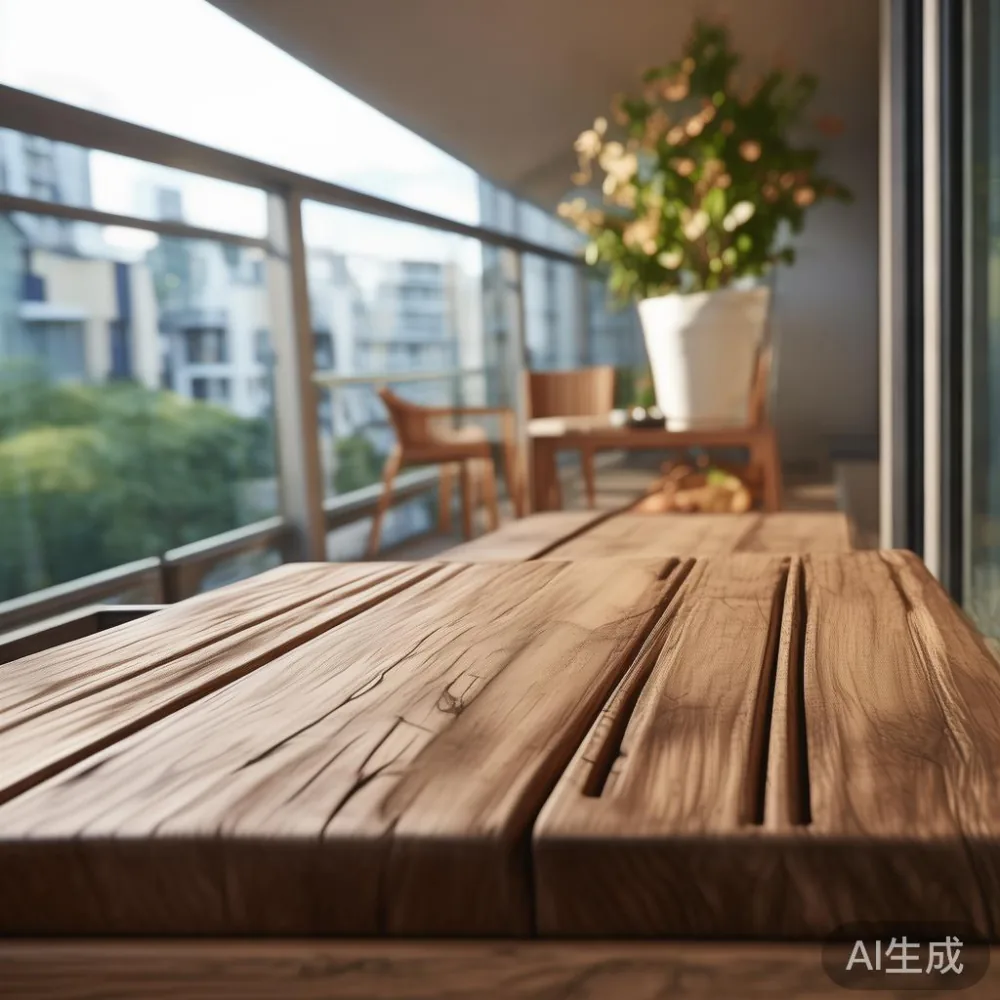
Balcony furniture has its own delivery checklist because the piece has to survive monsoon rain, afternoon UV at HDB level 12, and a 1.2 m wide HDB service yard gate when the lift is busy. A standard HDB balcony is about 3.0 m to 4.5 m long and 1.2 m to 1.5 m deep, with a parapet at 1.0 m and a sliding door at the living room end. The weight of your set matters because you do not want to load one corner of the slab with more than 150 kg without spreading it. Teak, shorea, and acacia solid wood sets run between 18 kg and 45 kg per piece and survive Singapore weather far better than hollow PE rattan or powder-coated aluminium that chips at the welds.
Balcony furniture also has to fit through that 0.9 m fire-rated door at the living room, then the same lift, then the same corridor. A foldable balcony set at 1.2 m by 0.6 m folded is much easier to deliver than a fixed 1.5 m bench that has to come in one piece. Cushions are usually shipped separately in a 0.5 m by 0.4 m by 0.3 m box, weighing 4 kg to 8 kg, which is easy for the delivery team. If you are ordering a balcony furniture set, ask whether the frame is fully welded or knock-down, and whether the covers are zippered and washable; a balcony in Tampines or Bedok gets dusty fast.
What is the smartest way to plan a balcony furniture online order?
Start with a 1:1 paper plan. Tape out the footprint of every piece on the balcony floor with masking tape, including the 60 cm clearance for the air-conditioning outdoor unit and the 30 cm gap you want behind every chair for wiping down rainwater. Measure the width of the balcony door threshold at the sliding track, because some HDB sliding doors have a raised track that adds 4 cm of lift height. Photograph the lift lobby, the corridor turn, the staircase if relevant, and the unit door, then send all five photos to the seller in a single email before you pay.
Choose a foldable or modular balcony furniture set over a fixed one if your lift is the standard 1.1 m wide. Choose a fixed set only if you have a service lift at 1.5 m wide or a ground-floor unit with direct access. Insist on solid wood, kiln-dried to under 12 percent moisture content, with stainless steel 304 hardware for the balcony brackets. Confirm the warranty in writing: ten years on the structure is the gold standard in this category. Confirm refinishing: lifetime sanding and re-oiling means your balcony furniture can be sent back every five years and come back looking new, which is a real saving over a 15-year ownership window.
Will the team actually assemble the furniture, or do I need to?
For most online furniture sellers in Singapore, assembly is a paid add-on of 49 to 109 SGD per piece, and it usually includes Allen key assembly for a bed frame, screwing on legs for a dining table, drawer runners for a wardrobe, and basic alignment for a nightstand. What it rarely includes is wall-mounting of a wardrobe to the HDB wall (which requires a 6 mm masonry drill and green plug), mounting of a heavy mirror above a marble top console, or hoisting a 45 kg bed frame up a narrow spiral staircase. Ask specifically whether the quoted assembly includes these scenarios before you assume it does.
A reliable indicator is whether the seller sends a single technician or two. One technician means a 30-minute limit per piece, which works for a bedside table or a small nightstand but not for a 6-drawer wardrobe. Two technicians means 45 to 90 minutes per piece, which is what you actually need for a 1.8 m solid wood bed frame or a 2.0 m wardrobe. MIDHILL, for example, sends a two-person team for any order over 30 kg and bundles thirty minutes of on-site assembly into the free-shipping tier, which is a sensible baseline. If the seller only offers one and your job is big, budget another 80 SGD for a handyman on the day.
What is the return and exchange reality once the box is open?
Most Singapore sellers offer a 14-day return window for unopened boxes, and a much narrower exchange-only window once the item is assembled. A 50 to 150 SGD return freight fee is applied for bulky items, and custom-made pieces are often non-returnable except for manufacturing defects. If you receive a piece that has a 3 mm scratch on the top of the marble table or a slightly wrong wood tone on the nightstand, the smart move is to document it with timestamped photos within 24 hours, then email the seller with the photos rather than refusing the delivery outright. A partial refund of 5 to 15 percent plus a refinishing voucher is the usual settlement.
For a French light luxury dining set, where every piece is finished by hand and the colour will vary by 5 percent between samples and the real product, a return on the basis of "the colour is slightly different from the website" is almost always refused. For a Korean or Japandi budget under 1000 SGD dining set shipped from Korea via sea freight, the return freight alone can exceed 300 SGD, which wipes out the savings. The honest math is this: a 14-day return sounds generous until you add 250 SGD of return freight plus a 15 percent restocking charge, then a 9 percent GST you cannot recover. Order carefully, measure twice, confirm with photos in writing, and the return policy becomes a backstop rather than a plan.
Any final practical tips before I click "place order"?
Keep a one-page project sheet. On it, write the piece, the dimensions in cm, the weight in kg, the lift width and depth, the corridor width, the unit door width, the floor of your unit, the date you need it by, and the budget in SGD including delivery, assembly, GST, and contingency. Photograph the lift lobby, the corridor, the staircase if relevant, the unit door, and the intended location. Send the project sheet and the photos to the seller. Ask for a written quote including delivery, assembly, packaging removal, GST, and the warranty in years. Compare three sellers on the same project sheet. The cheapest quote is rarely the best one; the clearest is.
For balcony furniture specifically, insist on solid wood, kiln-dried, with stainless hardware, foldable or modular if your lift is standard, and a warranty that covers at least five years on the structure plus lifetime refinishing on the surface. MIDHILL is one of the solid wood makers in Foshan that meets all of these, with a 10-year structural warranty and lifetime refinishing, which is why I mention them in the context of long-term ownership rather than a one-off purchase. Pay a 30 percent deposit to lock the order, 60 percent on delivery, and 10 percent after thirty days once you have lived with the piece and confirmed no movement, no warp, no squeak. That final 10 percent is your real protection, and the only use you will ever have after the carton has been carried away.