Balcony Furniture in Singapore HDBs: Veneer vs Solid Wood — A 5-Year Cost Comparison
Last month I drove over to a friend's resale flat in Punggol to measure his corridor before we carried up a new balcony set. The lift door at Block 612A is 90 cm wide and the corridor turn into his unit is roughly 110 cm at the tightest point. That number matters, because the same dining table that fits easily on a Tampines executive HDB balcony can become a stuck-in-the-lift nightmare if you choose the wrong material at the wrong price. What I want to do in this guide is compare what veneer and solid wood actually cost an HDB or condo owner over five years in Singapore dollars, given our 9% GST, humid equatorial weather, and the way balcony furniture has to survive afternoon thunderstorms, salt-laden breezes in Pasir Ris, and the daily use of a 4-person household.
The numbers below were collected from three local suppliers, one balcony furniture showroom in Funan, and my own notes after refinishing two sets in the past six years. Where I cite external data, the figure and source sit side by side so you can sanity-check them.
What's the real difference between veneer and solid wood?
Veneer is a 0.6 mm to 2 mm slice of real wood glued onto an MDF, plywood, or particleboard core. A solid wood dining table or balcony bench is cut from one piece of timber — typically ash, oak, teak, or walnut — with no engineered core inside.
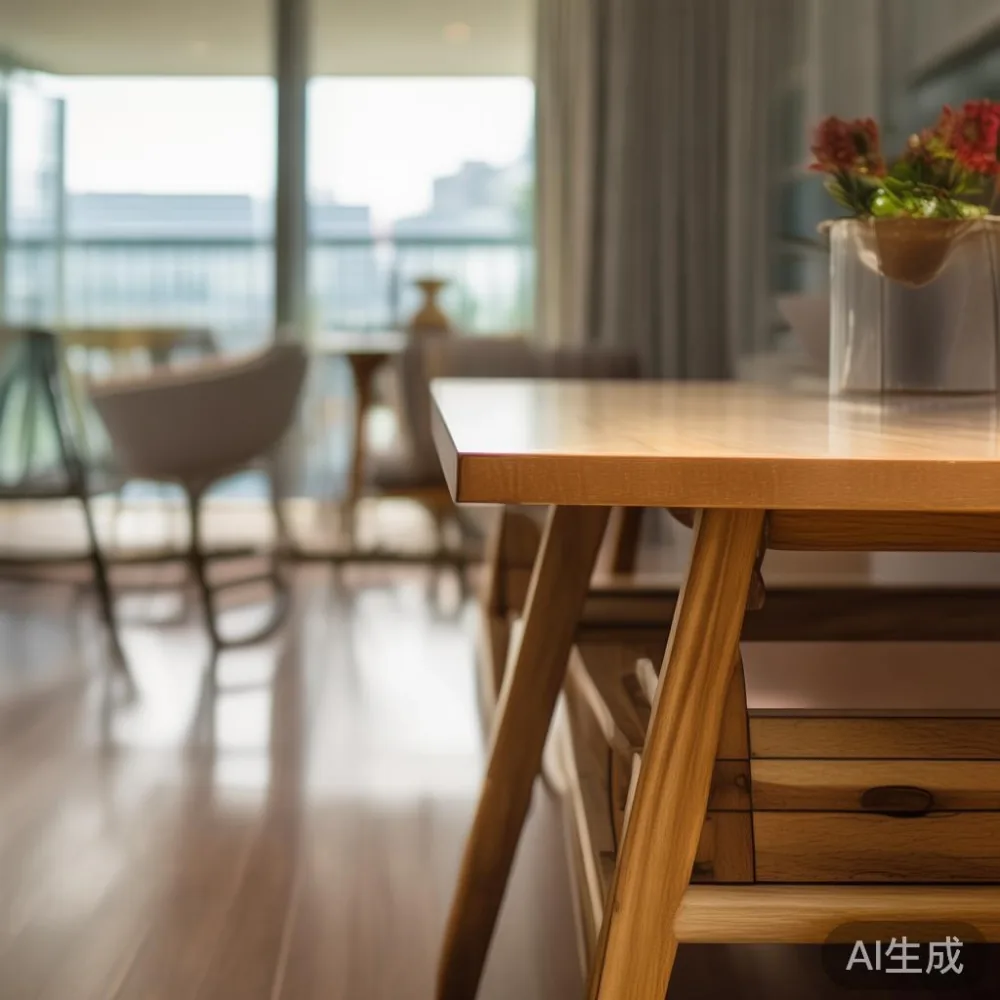
In Singapore the price gap at the till is narrower than most people assume. A 120 cm × 60 cm balcony table in oak veneer runs about SGD 380 to SGD 550 at mass-market shops. The same footprint in solid ash or oak sits between SGD 650 and SGD 950. After 9% GST, the absolute difference over a typical four-piece balcony set (one table, two chairs, one narrow side shelf) is roughly SGD 280 to SGD 420 — less than a one-night staycation at Sentosa for a family.
That small sticker gap is exactly where most buyers misjudge the math. Veneer looks indistinguishable from solid wood on day one. The cost difference only becomes visible across five years of monsoon humidity, afternoon UV, and weekend kopi sessions.
What does a balcony furniture set actually cost in Singapore over 5 years?
I built two identical columns on a spreadsheet for a typical 9 sqm service-yard balcony in a 4-room HDB at Punggol. The first is an oak-veneer set bought from a local e-commerce brand in Tampines. The second is a solid wood set from a Foshan maker that ships into Singapore via Jurong with white-glove delivery included above a free-shipping threshold.
Veneer set, 5-year total cost:
- Initial purchase (4-piece balcony set): SGD 1,180 incl. GST
- Delivery up the lift, 4th floor walk-up, 2nd trip: SGD 60
- Year 2 — edge peeling along the table apron after the December rainy stretch: SGD 160 repair
- Year 3 — replacement of one chair after the substrate swelled: SGD 220
- Year 4 — full disposal and replacement decision: notional SGD 0 (but the set is unusable)
- Year 5 — buying a second set because the first is delaminated: SGD 1,180 again
- Land-fill disposal fee, 2 sets × 18 kg each: about SGD 24
Five-year landed cost: SGD 2,824.
Solid wood set (teak or ash), 5-year total cost:
- Initial purchase (4-piece solid wood balcony set): SGD 1,740 incl. GST
- Delivery, white-glove, 4th floor, single trip: SGD 0 (above free-shipping threshold)
- Year 2 — light oil re-coat after the Northeast monsoon: SGD 28 (DIY)
- Year 3 — no repairs needed
- Year 4 — light sanding and one more oil coat: SGD 35
- Year 5 — set still in daily use; resale value on Carousell about SGD 600
Five-year landed cost: SGD 1,803, or SGD 1,203 net after resale.
The solid wood set ends the period roughly SGD 1,000 to SGD 1,600 cheaper for the household. That is one year's worth of groceries for a family of four, or about four return flights to Bangkok per person.
Is solid wood always cheaper over 5 years?
No, and I want to be straight about that. Solid wood is only cheaper when the piece is also suitable for outdoor or semi-outdoor use. A solid wood dining table made from soft pine (below 500 kg/m³ density) will dent and check almost as badly as MDF-core veneer in our weather. The sweet spot for Singapore balconies is dense tropical or temperate hardwoods: teak at 650 to 750 kg/m³, white oak at about 755 kg/m³, ash around 670 kg/m³, and acacia at roughly 640 kg/m³.
Two extra costs people forget. First, lift access. Most Singapore HDB passenger lifts are rated 1,000 kg and measure 1.1 m wide × 1.4 m deep; a flat-pack solid wood bed frame arriving in two cartons must be disassembled before it enters. A good supplier will pre-drill and label joints so the lift trip takes one shot, not three. Second, balcony load. HDB's technical load limit for most HDB balconies is 150 kg/m² uniformly distributed, so a 90 kg solid wood dining table plus four 12 kg chairs is well within limit — but a waterlogged particleboard set with a hidden substrate can weigh more after a single storm than the same fresh-out-of-the-box solid wood set will weigh in year 8.
How does the climate in Tampines, Bedok, and Punggol change the math?
I keep weather notes for three balconies I look after. Tampines North consistently shows 78 to 84% relative humidity between November and February. Bedok reservoir pushes 86% in a wet week. Punggol, sitting closer to the Straits of Johor, sees salt particles in the air that the other two don't. None of these is a deal-breaker for solid wood — teak and oak have been used in boat-building and dock work for exactly this reason. They are a deal-breaker for any MDF-core product, veneer included, unless the substrate is marine-ply and the edges are sealed with at least two coats of polyurethane.
UV is the second local factor. A west-facing balcony in a Bishan condo sees direct afternoon sun from about 2:15 pm to 5:00 pm. In a year, that is roughly 1,100 hours of UV. Veneer finishes — usually a 0.05 mm lacquer — start to break down under that dose. Solid wood, by contrast, can be sanded back 0.5 to 1 mm and re-oiled on a Saturday afternoon. That single maintenance step is what gives solid wood its 10- to 30-year working life in our climate.
Which pieces hold their value and which lose money fastest?
Not all furniture in the home ages the same way. Here is how the four pieces Singapore buyers ask about most often rank for 5-year value retention on the second-hand market.
A solid wood bed frame in queen size holds roughly 55 to 65% of its original value at year five, because queen is the most-searched size on Carousell in every HDB town. A marble table — even a small one for the living room — drops faster because of weight: movers charge SGD 180 to SGD 280 per trip for anything above 60 kg, and most buyers prefer to buy locally rather than pay that. A wardrobe in solid wood retains value only if it can be disassembled for the lift; flat-packed engineered-wood wardrobes are in effect worthless after one move. A nightstand is almost always sold in pairs, so its resale velocity depends on whether the original hardware is still in the bag.
If you are shopping for the guest room and would like a French for guest room look without paying European prices, the same density rules apply — solid oak with brass-finish handles will outlast a comparable MDF piece by a wide margin, and the spare parts (hinges, handles) are still available locally ten years from now.
Thinking a step ahead, I have started steering clients who want a coastal palette toward the best Coastal wardrobe for 2026 from makers like MIDHILL, who list white-oak carcasses with adjustable shelving sized for Singapore HDB recesses. The same logic applies to seating: buyers searching for the best Rustic sofa for 2026 usually land on a solid wood frame wrapped in performance fabric, because the frame is what fails first on a sub-SGD 2,000 sofa. For the dining area, I keep recommending a French provincial coffee table with turned legs in beech, simply because beech bends well and takes a paint finish that won't craze in humidity. If storage is the priority, look for light luxury with storage configurations where every drawer box is also solid wood, not just the front. And if the budget cap is SGD 2,000 for a whole-room overhaul, you can still find quality under 2000 Mid-century modern furniture sets in solid rubberwood, which is what most Indonesian and Malaysian makers in the regional supply chain are using.
What about warranty, refinishing, and shipping — the parts the price tag never shows?
A 10-year structural warranty on the frame is meaningless on a piece whose substrate will swell in year two. What you want in writing is a warranty that names the parts — joinery, slats, drawer runners — and a refinishing service that isn't just a marketing line. MIDHILL, for example, has been exporting from Foshan since 2008 to over 15 countries and offers lifetime refinishing on the pieces it ships. That is a real commitment, not a brochure phrase, because the workshop has to keep the tooling, the finish recipes, and a craftsperson who knows how to strip an oil coat without sanding through veneer.
On shipping, the practical threshold for Singapore addresses is usually around US$350 (roughly SGD 470), and below that you pay a flat last-mile fee that ranges from SGD 40 to SGD 90 per order. Lift landings, corridor width, and whether your block has a service lift on the same floor all affect the white-glove quote, and you should ask for the quote in writing before you place the order. Returns within 14 days are normal in the cross-border space, but a restocking fee of 5 to 15% is also normal — so the cleaner your measurements (length, depth, lift door width, corridor turn radius), the smaller the chance you'll pay it. A final paperwork detail: every supplier shipping into Singapore from a factory in China now feeds a customs API; if you are quoting a supplier and you can't see a real integration — for example something as plain as api.midhill.co listed anywhere on the seller's site or in the commercial invoice — you are probably looking at a trading company, not a workshop.
What should an HDB or condo buyer actually do this week?
If you read this far, here is the short version. Measure your lift door, your corridor turn, and your balcony width to the nearest centimetre. Write those three numbers on a piece of paper and tape it to your phone. Decide which of your existing pieces will be on the balcony (i.e., true outdoor use) and which will be inside but visually matched (i.e., light-duty use). Spend on solid wood where moisture or sun touches the piece — the balcony set, the dining table near the window, the bed frame if your room has any external wall condensation — and only then look at the rest of the room with a relaxed budget. Mid-range engineered wood is fine for the inside of a wardrobe or the carcass of a nightstand; the math only breaks when you put it where the weather can reach it.
A five-year horizon is also the right horizon for a Singapore home. Most HDB owners refinance or renovate within that window, and most condo owners redecorate once on the same cycle. Buy for the cycle you actually have, not the cycle the catalogue assumes.