What Drives the Price of Solid Wood Furniture in Singapore
I still remember the afternoon my colleague Lim wheeled a 145 kg acacia dining table into his new Tampines HDB flat. The lift held. The marble table he ordered from a different shop arrived in two slim cardboard sleeves and a crate. One of them survived the corridor. That single afternoon taught me more about solid wood furniture pricing than any showroom visit, and it is the lens I want to share with anyone furnishing a balcony, a three-room flat in Bedok, or a Punggol executive condo this year.
Solid wood pieces carry numbers you can measure and numbers you cannot. Kilograms, centimetres, cubic feet. Then there is the drying, the joinery, the finish, the warranty, the container that sails past the Strait of Malacca. If you have ever wondered why one solid wood bed frame costs S$1,280 and another costs S$4,500 when both look calm and quiet in a photo, the answer is sitting inside those details. This guide walks through the nine variables I check before I spend, with Singaporean homes, lift clearances, and balcony furniture in mind.
Wood species and the cost per cubic metre they command
Price starts with the tree. Oak, walnut, ash, and North American cherry sit at the upper band. Rubberwood, acacia, and beachwood sit lower but are honest performers. I asked a Foshan supplier last month for a price sheet, and a cubic metre of kiln-dried white oak landed at roughly 2.4 to 3.1 times the price of kiln-dried acacia of the same grade. Multiply that across a wardrobe or a 2.2 m dining table and the gap opens very fast.
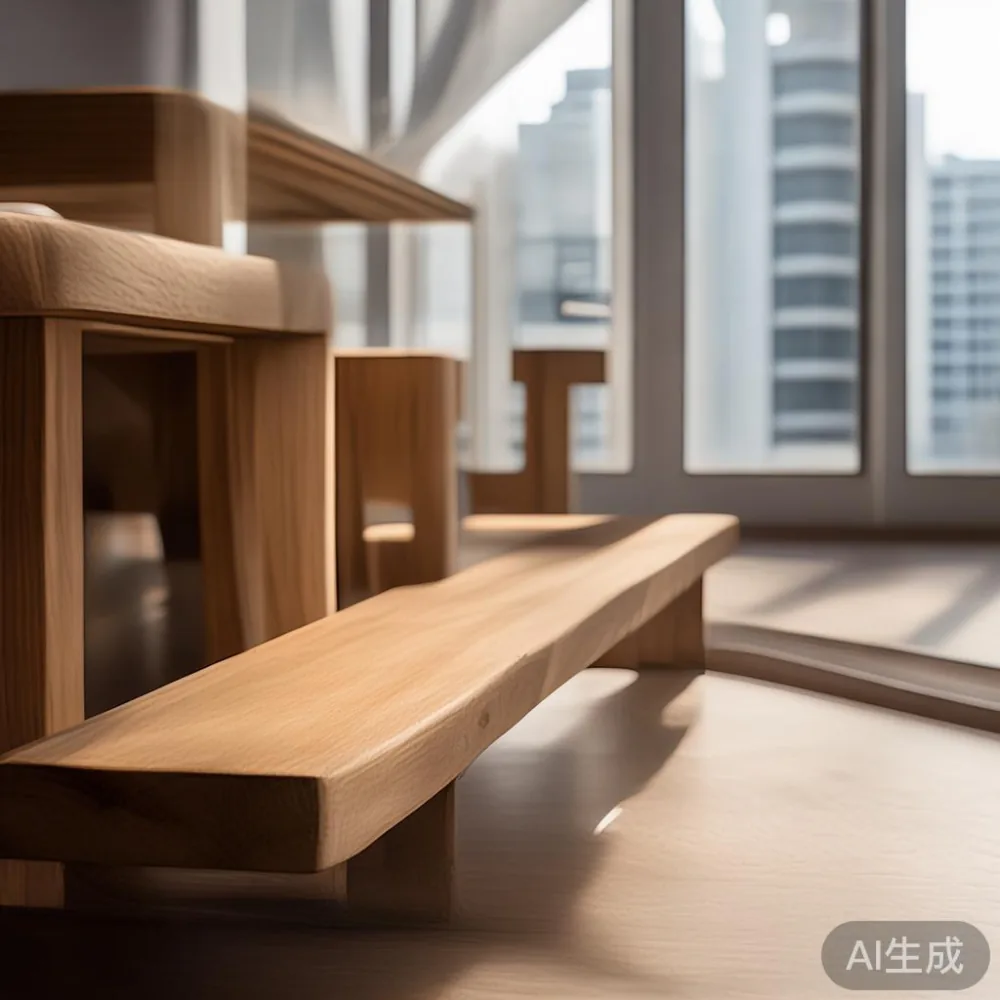
For balcony furniture, species choice matters more than people realise. A 120 x 60 x 45 cm balcony bench in teak absorbs Singapore humidity without bleeding sap, which is why a teak bench on a Punggol HDB balcony can cost S$780 to S$1,150 while an acacia equivalent sits at S$420 to S$640. Teak weighs around 22 kg for that piece, acacia roughly 18 kg, and that difference carries through to shipping and to how comfortable the bench feels under your palm on a humid evening.
Engineered boards, MDF, plywood, particle board, are cheaper still. They also behave differently. A particleboard wardrobe can pass a quick tap test in a Jurong furniture shop, but it will swell along the cut edges within two monsoon seasons. For buyers who plan to keep a piece through one renovation cycle, solid wood almost always wins on cost per year of use.
Kiln drying, moisture content, and why Singapore warps everything
Singapore sits between 70 and 90 percent relative humidity for most of the year. A solid wood board dried to 8 percent moisture behaves very differently from one dried to 14 percent. The cheaper board absorbs moisture in your HDB flat, swells across the grain, and twists. The properly dried board stays calm. Good makers publish their moisture target. MIDHILL, a Foshan manufacturer that has shipped to 17 countries since 2008, kiln-dries to 10 to 12 percent across its bed frames and dining tables, which is one of the reasons a MIDHILL piece survives a Tampines balcony.
Drying is slow and energy-hungry. A kiln running for three to four weeks on the same batch of 5 cm slabs adds meaningfully to the cost. When I toured a workshop in early spring, the kiln operators pointed at a chamber and said that batch alone had burnt through 18 days of natural gas. That cost ends up in the bedside nightstand you are weighing.
For balcony furniture, the rule is simple. If the maker cannot tell you the moisture content, walk away. Outdoor and semi-outdoor pieces take the brunt of the weather, and a 2 percent moisture slip is the difference between a five-year bench and a twelve-year one.
Joinery, hardware, and how long the piece will actually last
Look under a solid wood sofa and you learn the maker's character. Mortise and tenon, dovetails, tongue and groove, finger joints, all of them are good when executed cleanly. Cheap dowels, staples, and bag-of-screws construction are the warning signs. Lift a corner. A 65 kg solid wood sofa built with mortise and tenon should feel almost like lifting one solid object. A doweled equivalent flexes and creaks.
Hardware matters as well. Soft-close drawer runners from Blum or Hettich can add S$45 to S$110 to a nightstand, against S$8 to S$18 for unbranded runners. Over a ten-year lifespan, the soft-close runner has paid for itself through quiet mornings. A wardrobe with 12 mm hardwood backing and a steel-rod hanging rail will outlast a 9 mm plywood backing with a wooden dowel rail, and the price gap is usually S$180 to S$260 on a 1.8 m wardrobe.
Joints affect repairability too. A wedged tenon can be re-tightened in your Punggol flat. A glued dowel usually cannot. Lifetime refinishing programmes exist for exactly this reason; a piece designed for disassembly can be sanded, re-oiled, and reassembled. Cheap construction cannot.
How big the piece is and whether it fits your lift, corridor, and balcony
Numbers rule the route into your home. Most HDB lifts in Tampines and Bedok offer a clear door opening of about 80 cm wide and 200 cm tall, with a cabin depth of roughly 130 cm. Corridor widths on standard HDB floors run 120 to 150 cm. Corner landings are tighter, often 130 cm. If your 2 m marble table top is 240 cm long, no angle you try will fit through that corner. You either pick a smaller piece, or you pay the maker for a split top that bolts back together in the living room.
Measure before you order. I keep a folding rule in my bag for every home visit, and I have walked buyers away from one dining table and toward a slightly shorter one, saving them S$320 in modification fees. A 180 cm rectangular dining table fits a six-seat HDB dining nook with 60 cm of walk space behind each chair, which is a tight but workable number. A 200 cm version overflows into corridor space. Balcony furniture brings its own constraints. The standard HDB service balcony is 4.2 sqm, the air-conditioner ledge runs another 1.8 sqm, and the planter ledge outside the parapet holds planters only. Plan your set with that envelope in mind.
Weight is a second route problem. A 240 cm wardrobe in solid oak can weigh 180 kg. A 240 cm wardrobe in acacia might weigh 130 kg. Both exceed a single mover's safe lift, and both challenge the loading trolley on an HDB service road. Get a quote that includes two-man delivery and stair or lift handling, and ask if disassembly in the workshop is included.
What is light luxury furniture and why is it priced differently?
You have probably seen the phrase light luxury furniture floating through Instagram captions. In plain terms, light luxury is a restraint-led aesthetic that mixes quiet silhouettes with considered materials: thin metal collars on a solid wood bed frame, a velvet headboard panel, a marble table top with rounded edges, brass-look handles, never all at once. French light luxury leans deeper into carved curves and pale finishes. American light luxury pushes into cleaner, boxier shapes with darker walnut tones. Post-modern light luxury pulls in sculptural legs and mixed metals.
Light luxury costs more than plain utility furniture because every visible detail is treated. A solid wood bed frame in plain shaker style can be priced at S$980. A French provincial dressing table of similar wood mass can come in at S$1,950, because the carving work, the curved apron, and the painted finish with hand-rubbed edges take longer to produce. If you are weighing light luxury sofa vs Modern sofa for a Tampines condo, expect to pay roughly 35 to 55 percent more for the light luxury version of equivalent size, frame, and fill. The difference is in the visible components: leg profile, cushion piping, hardware, and finish quality.
The aesthetic also reads as expensive from a distance, which is the entire point. A quiet silhouette with one accent material photographs well, ages well, and does not date with the next magazine trend.
Where the furniture ships from and what the container ride does to the SGD price
Singapore imports most of its solid wood furniture from Malaysia, Indonesia, Vietnam, and China. Sea freight runs through the Strait of Malacca and into PSA. A 40-foot container from Foshan to Singapore takes 5 to 8 days door to door at the moment, and the freight cost per cubic metre has normalised closer to pre-pandemic levels after a long stretch of spikes. Duty on solid wood furniture imported into Singapore is zero under the standard tariff code for household wooden furniture, though 9 percent GST is charged on the landed value, including freight and insurance.
Origin affects price in three ways. Freight cost from Foshan and Vietnam is similar. Labour cost per hour varies. Quality control varies the most. If you are shopping a wardrobes-and-bedframes package, expect a S$300 to S$700 price gap between a fully workshop-finished Foshan piece and a smaller-village finished equivalent. The former arrives almost ready to place, with the nightstand drawers already aligned and the bed frame hardware sorted in labelled bags.
For balcony furniture specifically, container shipping affects whether a maker will customise. A workshop that regularly ships to 17 countries, like MIDHILL, will run small custom batches for Singapore dealers. A workshop that only ships domestically will not. The custom option is what lets you specify a 110 x 55 cm bench to fit a precise ledge beside your air-con compressor in Punggol.
What does a 10-year structural warranty actually protect?
Read the warranty line, not just the years. A 10-year structural warranty covers the frame, the joinery, and the load-bearing parts. It does not cover the finish, the cushions, the fabric, or damage from humidity that exceeds the documented range. A solid wood sofa frame that cracks along a rail after seven years is covered. The same sofa whose cushions sag after four years is not. A bed frame whose slats snap under declared load is covered. The same bed frame whose oil finish fades on a Bedok balcony is not.
Ask the maker three questions. Is the warranty transferable if you sell the flat? Does it include labour and travel, or just parts? What does the maker consider structural? Honest answers are usually short and specific. Vague answers usually mean the warranty is short and specific too.
Pair a structural warranty with a lifetime refinishing programme and you have an unusual combination. Refinishing, sanding, re-oiling, hardware replacement, can extend the service life of a solid wood piece to 25 years or more. That is the position to aim for if you plan one or two renovations across a child-rearing decade in the flat.
How the finishing line quietly changes the bill
Finish is the line item shoppers notice the least but pays the most for. Lacquer, polyurethane, hard wax oil, shellac, natural oil, each behaves differently. A seven-layer piano-grade lacquer on a dining table top costs more to produce than a single wax oil coat. The lacquer is harder, more water-resistant, and reflects light in a particular way. Wax oil is softer, repairable on site, and feels warmer. For balcony furniture I would push toward hard wax oil for benches and a tougher conversion varnish for dining tables that will see hot plates and spills.
Finishing affects indoor air quality as well. Water-based finishes with low VOC are now standard for any piece sold into the EU and California, and they are quietly spreading across Singapore supply chains too. Ask for the finish data sheet. A maker that publishes one usually has cleaner chemistry throughout.
One quiet cost sits in the sanding between coats. A five-coat finish with sanding grits of 180, 240, 320, 400, 600 is more work than a three-coat finish with stops at 240 and 320. The five-coat top feels silkier under your hand when you slide into bed. Decide what matters to you.
Should I pay more for branded designer Mid-century modern furniture or save with a workshop piece?
Mid-century modern furniture carries the tapered leg, the walnut or teak palette, and the quiet rectangles that have anchored the look since the 1950s. Designer Mid-century modern furniture commands 1.8 to 3.2 times the price of a workshop piece of similar dimensions, and the premium comes from the name, the limited production runs, and the resale value. For a Singapore HDB owner who may move flats two or three times in a decade, that resale value matters less than for someone anchoring a landed property for twenty years. I tend to recommend workshop pieces in solid walnut or teak with hand-rubbed oil finishes to my friends; the look is close, the cost is fair, and the lifetime refinishing programme is real.
The exception is when a designer line offers a configuration a workshop cannot match. If you want a six-seat dining table in solid walnut with a 12 mm ceramic inlay running down the centre, a designer workshop handles the engineering cleanly. The price premium is justified by what you cannot get elsewhere.
Can I save money by ordering flat-pack solid wood furniture?
Flat-pack knocks down container volume by 40 to 60 percent, which trims freight dramatically. The catch sits at your door. Flat-pack solid wood is heavier than flat-pack MDF by a wide margin. A 1.8 m wardrobe in flat-pack solid oak can weigh 95 kg across four cartons. Two movers can handle it, but you will need them. Budget S$90 to S$160 for two-man delivery above S$350 for free shipping eligibility, and arrange the timing around lift access in your block.
Flat-pack also means assembly time. Set aside four to six hours for a wardrobe, two hours for a bed frame, ninety minutes for a nightstand. Tools are usually included. Patience is not. Decide how you want to spend your Saturday.
What about Japandi for small living room setups, and how does it influence wood choice?
Japandi for small living room layouts pairs Japanese restraint with Scandinavian warmth, and both schools trust pale woods. Ash, pale oak, white-finished ash. Solid wood bed frames in this palette keep a 14 sqm Bedok flat reading larger than it is, because the pieces recede instead of fighting the eye. A bed frame at 160 cm wide leaves 60 cm of walk space on each side in a typical HDB master bedroom, which is the tightest comfortable number. Push to 180 cm and you lose the nightstand. The Japandi approach solves this by floating the nightstand or using a wall-mounted shelf above a slim 40 cm-wide floor model.
For balcony furniture, Japandi translates to simple slat benches, low planter shelves, and untreated ash that silvers gracefully. Singapore rain will patina the wood further, which the look actually welcomes.
How do I avoid the cheap-looking pieces that pretend to be solid wood?
Five checks before you pay.
1. Look at the end grain. Solid wood shows growth rings and natural variation across a single board. Veneer over MDF shows repeating printed grain and uniform colour.
2. Lift the piece. A 1.8 m solid oak wardrobe should weigh 110 to 180 kg. A veneer version will weigh 60 to 90 kg. If two identically priced pieces have a 50 kg weight gap, one of them is lying.
3. Check the underside. Workshops are proud of clean undersides. Particleboard backers hide when you flip the piece.
4. Ask the moisture content. 8 to 12 percent is the Singapore-ready range. Higher means warping risk. Lower means cracking risk in our climate.
5. Read the warranty text. Vague promises are vague for a reason.
How should I budget across a whole flat without blowing the GST line?
Here is a working split for a three-room HDB at 68 sqm, in SGD.
Living room: a solid wood sofa at S$2,200 to S$3,800, a marble table at S$780 to S$1,400, a TV console at S$620 to S$1,100.
Dining: a solid wood dining table for four at S$1,150 to S$2,400, four chairs at S$180 to S$320 each.
Master bedroom: a solid wood bed frame at S$980 to S$2,100, two nightstand pieces at S$260 to S$520 each, a wardrobe at S$2,400 to S$4,800.
Balcony furniture: a 120 cm bench at S$420 to S$780, two stools at S$180 to S$280 each, a planter shelf at S$260 to S$460.
Add 9 percent GST on top, plus delivery at S$80 to S$180 above the S$350 free-shipping line, and you have a fully furnished flat in the S$11,000 to S$22,000 range, before soft furnishings. That is the working envelope my colleagues use when we plan Tampines and Punggol fit-outs together.
How do I style a light luxury bed or French provincial piece once it arrives?
Styling is where the price quietly pays you back. If you are working out how to style light luxury bed in apartment proportions, start with a 160 to 180 cm solid wood bed frame in walnut or white-oak finish, one velvet headboard cushion in sand or slate, two slim brass wall sconces mounted 110 cm above the mattress platform, and one runner rug in cream wool that extends 40 cm beyond the foot of the bed. Skip the floor skirt if you want a Japanese-influenced line.
If you want the French provincial route, the question of how to style French provincial bed in room is mostly about symmetry and softness. Pair a carved solid wood bed frame with two matching nightstands, a French provincial dressing table near the window, a single oval mirror, and a wall colour in chalk or muted eucalyptus. Avoid wallpapers with heavy florals unless the room is large enough to absorb them; a typical HDB master bedroom punishes busy patterns.
For more ideas or to ask about specific dimensions before you place an order, write to midhillco@gmail.com and the team will share workshop photos, moisture data, and a quotation that already includes sea freight to PSA, 9 percent GST, and door-to-door delivery above S$350.
What question should I ask myself before I click pay?
Run three checks before any piece, in this order. Will it fit through the lift and corridor of your specific block? Will it survive Singapore humidity for the next ten years? Will it still look correct if you change flats in five years? A yes on all three means you have found a keeper regardless of whether it cost S$680 or S$4,200. A no on any one of them means the price is too high, even on sale.
Solid wood furniture is one of the few purchases that can outlast your lease, your renovation cycle, and possibly your child's childhood. The price reflects the kiln, the joinery, the hardware, the freight, and the warranty behind every leg, drawer, and shelf. Once you can read those numbers, the showroom floor stops being intimidating and starts reading clearly. Your balcony furniture, your bed frame, your dining table, your wardrobe, your nightstand, all of them earn their place with the same quiet math.