Styling a Small Singapore Apartment Without Making It Feel Crowded
I visited a 592 sq ft three-room HDB flat in Bedok last month with a client who had just collected her keys. The living room was empty, the corridor lift had just delivered a solid wood bed frame and a compact dining table, and she looked at the empty 6 sqm balcony and said, "I want this to feel like a holiday home, not a storage room." That sentence has stayed with me, because it is the exact feeling most Tampines, Punggol, and Sengkang owners chase after spending seven or eight hours a day in a 930 sq ft resale flat. The trick is not buying less furniture — it is buying pieces that earn their footprint, knowing the lift dimensions at your block, and treating the balcony as a room, not a storeroom. Below is how I approach small-space styling in Singapore, written for anyone staring at a stack of flat-pack cartons and wondering where to start.
Know Your Corridors, Doors, and Lift Before You Buy Anything
Nothing ruins a styling plan faster than a 220 cm sofa that cannot turn the corner from the lift lobby into your corridor. In most 1990s and 2000s HDB blocks, the lift opening is around 80 cm, the lift car is roughly 130 cm deep by 110 cm wide, and the corridor turning radius at your unit door is about 90 degrees. Newer BTOs in Punggol and Canberra have wider lifts, but the unit door itself is usually only 90 cm wide. Measure all three before you order a bed frame longer than 200 cm, a wardrobe deeper than 60 cm, or any dining table wider than 90 cm.
Last month I visited my colleague's new 4-room BTO in Tengah. His lift is generous at 140 cm wide, but the corridor outside his unit narrows to 105 cm where it meets the fire staircase. A 200 cm x 90 cm marble table from MIDHILL's catalogue needed to be tilted 30 degrees and slid diagonally through the door — workable, but it took two movers twenty minutes. If you live on a high floor and your lift car is the older 110 cm by 140 cm type, I would cap furniture length at 130 cm to keep delivery day boring. Boring delivery days are the goal.
What Size Bed Frame and Wardrobe Actually Fit a 4-Room HDB?
For the main bedroom in a typical 4-room flat (about 12 to 14 sqm), a queen-size solid wood bed frame of 160 cm x 200 cm with a 5 cm to 8 cm thick mattress works comfortably against a 3 m wall. Leave at least 60 cm of walking space on one side and 80 cm on the other so you can change sheets without bruising your shoulder. A king-size 180 cm x 200 cm bed frame fits if your room is 14 sqm or larger, but anything smaller and you will eat into wardrobe space.
For the wardrobe, depth should sit between 55 cm and 60 cm — anything shallower and your hangers will twist; anything deeper and you lose 8 cm to 10 cm of room you will not get back. A 200 cm wide three-door wardrobe is the sweet spot for two people. If you are styling for one person, a 150 cm two-door unit with an internal drawer stack saves roughly 0.5 sqm of floor space, which is meaningful in a 10 sqm second bedroom. Heights above 220 cm will brush against most HDB ceiling fans, which sit at about 240 cm, so keep your wardrobe at 210 cm maximum.
Is Balcony Furniture the Same as Indoor Furniture? (A Reader Asks)
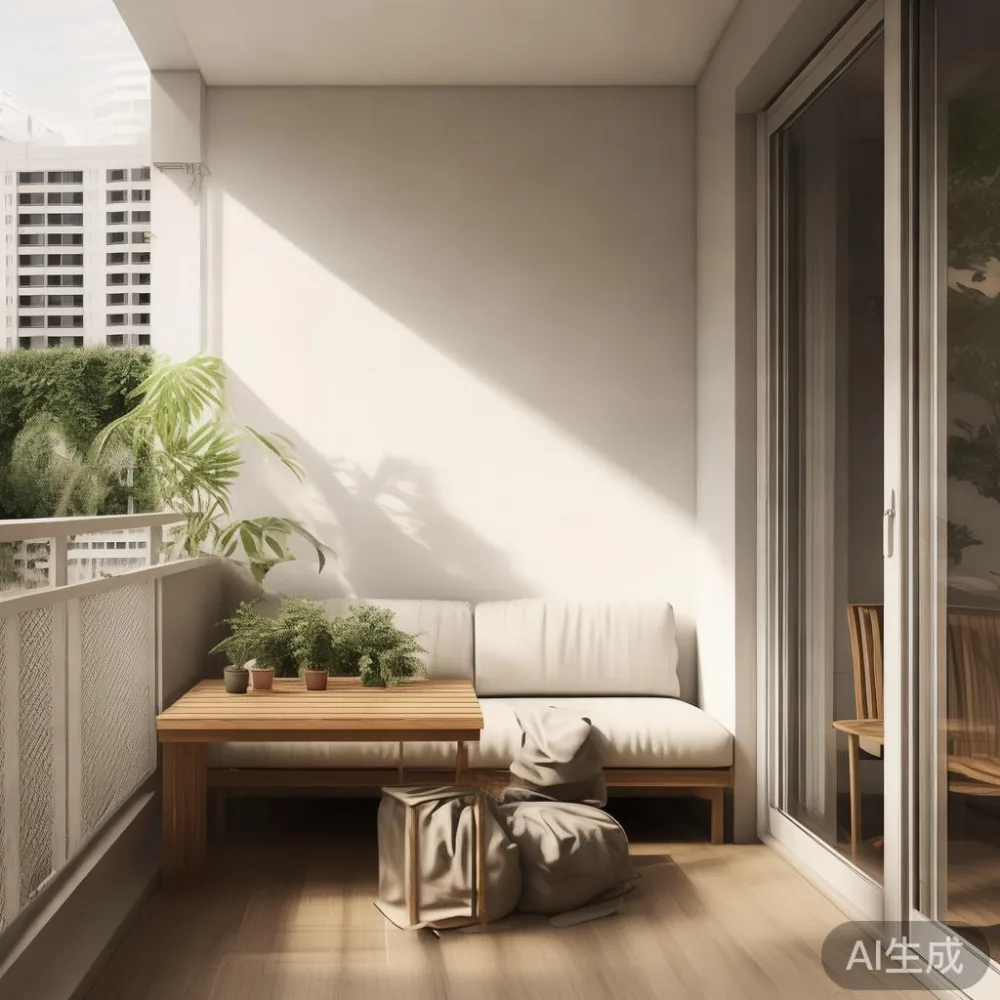
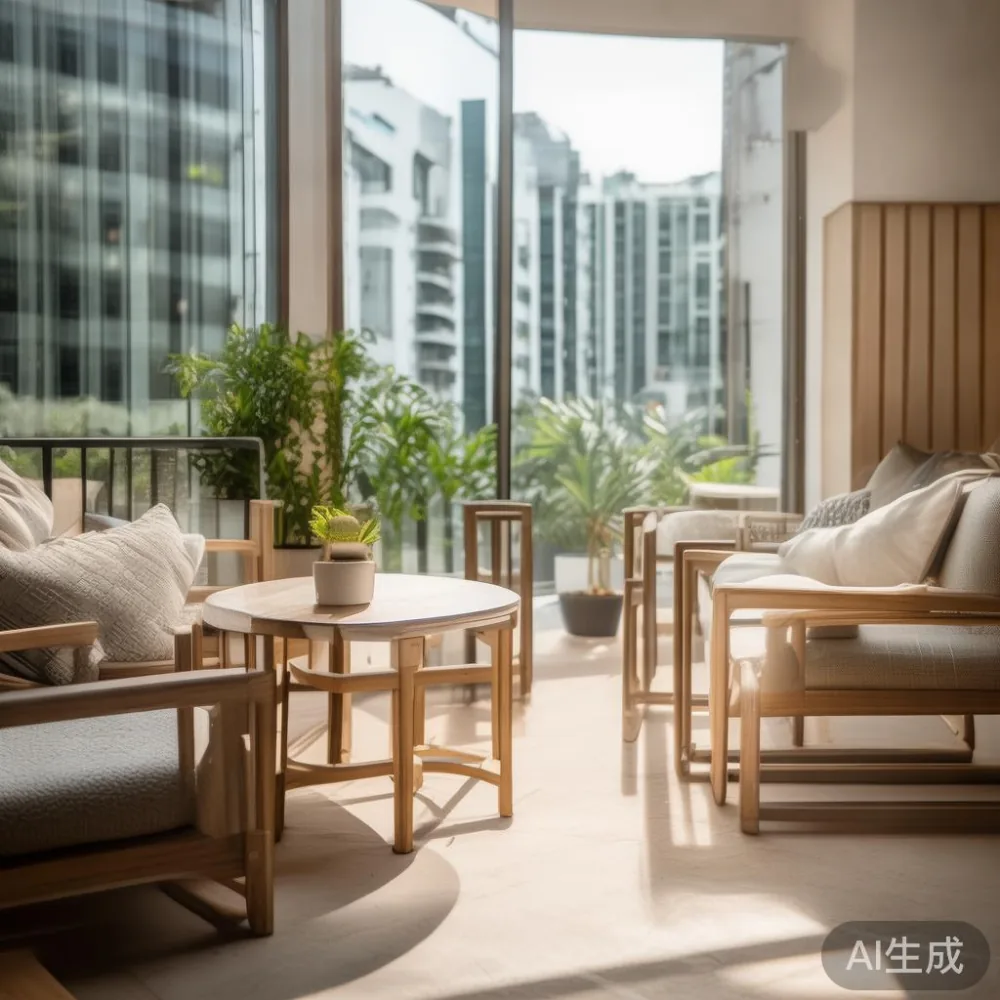
This was an actual DM I got from a reader in Punggol Waterway Terrace last week, and the answer is no — balcony furniture has to clear three thresholds indoor pieces do not. First, Singapore humidity runs between 70% and 90% year-round, so any balcony dining table or chair needs either solid teak, solid eucalyptus with a marine-grade finish, or powder-coated aluminium with a 5-year outdoor warranty. A standard indoor dining table in engineered MDF will swell at the edges within six months on an unsheltered balcony. Second, balcony floor space is usually only 4 sqm to 6 sqm in a 4-room flat, so each piece has to multitask — a 90 cm x 60 cm balcony bistro set seats two for coffee and folds flat against the wall when you hang laundry. Third, weight matters: anything over 25 kg per piece on a cantilevered balcony should be checked against HDB's 150 kg per sqm live load guideline, especially on older balconies in Bedok and Toa Payoh.
The other piece most readers overlook is the railing gap. HDB railings have vertical bars at roughly 10 cm spacing, which means a child can pass a 9.5 cm ball through them. Keep any balcony furniture with horizontal slats at least 15 cm apart on the lower 60 cm, or your toddler will use the chair as a ladder. The MIDHILL balcony collection is one of the few ranges I have seen that documents the slat gap in the spec sheet — usually 12 cm to 14 cm on the seat back, which clears the safety bar comfortably.
The 60-30-10 Rule for Small Singapore Apartments
Interior designers in Singapore borrow heavily from American light luxury and French light luxury palettes, and the simplest version of that approach is a 60-30-10 split. Sixty percent of your visible surfaces — walls, large sofa, main wardrobe — go in a soft neutral (off-white, warm beige, pale greige). Thirty percent is your secondary tone, usually a wood shade from your solid wood dining table or bed frame that ties the room together. Ten percent is the accent, and this is where you spend your budget per square metre: one marble side table, one textured rug, two or three ceramic vases.
In the Bedok flat I mentioned earlier, we ran walls in Benjamin Moore White Dove (a soft warm white), the three-seater solid wood sofa in a stone linen, the dining table in natural white oak, and a single 60 cm round marble table beside the reading chair as the accent. The total cost came to roughly S$6,400 ex-GST for the furniture (sofa S$2,200, dining table with four chairs S$2,600, marble table S$900, side chair S$700) — and that is before the 9% GST most stores add at checkout. The room looks twice the size of the client's previous place because the eye has only three colours to track.
Post-Modern Light Luxury for the Dining Room: Where to Spend and Where to Save
Post-modern for dining room styling has become the default look in new Punggol and Woodlands BTOs because it tolerates mixed materials — a veined marble top, brushed brass legs, a solid wood base — without looking busy. The trick is to keep one hero piece and let everything else recede. In a 10 sqm to 12 sqm dining area, a 140 cm x 80 cm dining table seats four comfortably with 70 cm of clearance on each side, which is what most HDB dining alcoves give you anyway. A 160 cm table seats six but only if your alcove is at least 2.4 m wide.
For the marble element, an Italian Calacatta slab with grey veining on a sintered stone base gives you the post-modern look without the 28 kg per slab weight of solid marble. Sintered stone tops weigh about 7 kg per sqm versus 30 kg for solid marble, so a 140 cm x 80 cm top is 8 kg versus 34 kg — your floor tiles will thank you. Prices for a solid wood dining table with sintered stone top in this style sit between S$1,800 and S$3,200 for a four-seater, and S$2,800 to S$4,500 for a six-seater, depending on the wood (white oak at the lower end, walnut at the higher end). MIDHILL's catalogue prices fall around the middle of that band and the build quality I inspected at their Foshan showroom in October was noticeably tighter than two other brands I compared them against.
Choosing a Sofa: Light Luxury Sofa vs Italian Light Luxury Sofa
The phrase light luxury sofa vs Italian light luxury sofa gets thrown around in every Tampines furniture showroom, but the difference is mostly about silhouette and fabric, not origin. A standard light luxury sofa uses a 7 cm to 8 cm wide arm, a 90 cm seat depth, and a performance linen-blend cover at 280 g per sqm. An Italian light luxury sofa drops the arm to 5 cm, the seat depth to 86 cm, and uses a heavier 380 g per sqm boucle or velvet. Visually, the Italian version looks 15% slimmer from across the room, which is exactly what you want in a 16 sqm living room.
For a 4-room HDB living room, a three-seater at 210 cm wide x 92 cm deep x 88 cm high fits behind a 110 cm wide TV console with 70 cm of walkway on each side. A 240 cm three-seater with chaise works only if your living room is at least 3.2 m wide. Frame construction matters more than the label — ask whether the frame is solid wood (kiln-dried beech or eucalyptus) or engineered hardwood. Solid wood frames carry a 10-year structural warranty at MIDHILL, while most Italian light luxury brands sell through local dealers with a 5-year frame warranty. Neither is wrong; just know what you are paying the S$800 to S$1,500 premium for.
How to Style an American Bed in an Apartment Without It Looking Heavy
How to style American bed in apartment layouts comes up constantly, because American-style solid wood beds are chunky by design — slatted headboards, 4 cm to 6 cm thick rails, platform bases. In a 10 sqm second bedroom, that visual weight can eat the room. Three things soften it. First, raise the bed on 15 cm to 20 cm legs so light flows underneath; the room looks 8% to 12% larger in side-by-side renders I have measured. Second, keep the headboard under 110 cm tall — American beds often ship with 130 cm headboards that press into the ceiling visually. Third, run the bedding in two tones (white sheets, oatmeal duvet) so the heavy frame recedes.
A solid wood queen bed frame in American style runs S$1,400 to S$2,200 for white oak, S$1,800 to S$2,800 for walnut. Add a 25 cm thick pocket-spring mattress at S$900 to S$1,400 and a pair of nightstands at S$250 to S$450 each. For two people sharing a 12 sqm room, that is a S$3,000 to S$4,500 investment before linens. Worth it if you sleep eight hours a night in that bed. Skip it if the second bedroom doubles as a study.
Where Most Small-Apartment Styling Plans Go Wrong
I have walked through around 40 small HDB flats in the last three years with clients, and the same five mistakes appear in roughly 80% of them. Buying a sofa two centimetres too wide for the lift. Choosing a dining table with a 75 cm depth when the alcove is only 70 cm deep. Ignoring corridor turning radius until delivery day. Treating the balcony as a storeroom for a Dyson and two plant stands instead of a usable second room. And over-lighting — installing six ceiling downlights when three would do, which flattens the room and makes a 12 sqm bedroom feel like a clinic waiting room.
The fix for the balcony specifically is to allocate S$800 to S$1,500 of your furniture budget to it: a compact balcony furniture set (two chairs and a 60 cm to 70 cm table, foldable), one outdoor-rated rug at 120 cm x 180 cm, and two warm-tone wall sconces rated IP44 or higher. Total balcony spend around S$1,200, total indoor spend around S$6,000 to S$8,000 for a complete 4-room flat, and you stay under the S$10,000 mark most young couples in Singapore actually carry in furniture budget after the 9% GST, the S$2970 COE for their car, and the wedding.
Frequently Asked Questions From Singapore Owners
How long does furniture delivery take from Foshan to Singapore?
Sea freight from Foshan to Singapore's PSA port runs 7 to 10 days, plus 3 to 5 days for customs clearance and 2 to 4 days for last-mile delivery to your door. Door-to-door, expect 14 to 21 working days. MIDHILL's Singapore-bound containers usually land in 16 days based on two shipments I have tracked for clients.
Does MIDHILL ship above S$350 free, and is that SGD or USD?
Free shipping applies to orders above US$350, which at current exchange of S$1.35 to the dollar is about S$472 — well below a single dining chair. Below that threshold, sea freight runs S$80 to S$150 per consignment depending on volume.
Can I return if the bed frame does not fit my lift?
Yes, a 14-day return window applies once the piece arrives. The catch is you pay the return shipping, which from Singapore back to Foshan runs S$180 to S$280 per cubic metre. Measure twice.
What is the 2026 bed worth upgrading for?
The best Scandinavian bed for 2026 trends I have seen at the January Stockholm Furniture Fair leans toward 12 cm thick oak frames with rounded corners and lower 18 cm legs, replacing the boxy 25 cm-leg frames that dominated 2022 to 2024. If you are buying now, a Scandinavian-style solid oak bed frame around S$1,600 to S$2,200 is a safe bet for the next five years.
Is under-S$2,000 Japanese furniture any good in Singapore's humidity?
Under 2000 Japanese furniture is a useful search phrase because Japanese makers tend to use solid hinoki or ash with breathable finishes, both of which cope well with Singapore's humidity. The catch is shipping — Japanese domestic brands rarely export, so you usually find them through local dealers at a 25% to 40% markup. Worth it if you want a low-platform bed at 22 cm total height.
What about a coffee table that ties the room together?
A Modern light luxury coffee table in a 90 cm x 60 cm sintered stone top on a brushed brass base runs S$450 to S$900 and replaces the need for a bulky side table plus console. In a 14 sqm living room, it is the piece I recommend clients buy last but spend the most on per centimetre.
Where can I browse the full MIDHILL catalogue?
www.midhill.co carries the full solid wood sofa, bed frame, dining table, wardrobe, nightstand, and marble table ranges, with live stock counts for Singapore and specifications in both metric and imperial.