Humidity and Wood Furniture in Southeast Asia: A Balcony Owner's Field Guide
I keep a small digital hygrometer clipped to the railing of my Tampines HDB balcony. Last month, on a still afternoon after a Bukit Timah thunderstorm, the reading sat at 86% RH. By 11 p.m. the same day it was 91%. That single number is the reason I started paying serious attention to how humidity in Southeast Asia affects wood furniture — and why my colleague, who runs a 92 sqm condo resale in Bedok, replaced a warped balcony bench within eleven months of moving in. Wood moves. In a climate where the average year-round RH hovers between 70% and 85%, it moves a lot.
Singapore's balcony has evolved from a laundry corner into a small living room with a view. Owners in Punggol, Sengkang, and the newer BTOs in Tengah are spec'ing out 6 to 12 sqm of outdoor space with the same care they once reserved for the living room . That means a solid wood sofa, a compact dining table, a slim wardrobe for cushions and gardening tools, and increasingly a marble table for evening coffee. The catch is moisture — from afternoon showers, sea spray in East Coast, and the daily condensation cycle that pushes RH from 65% at noon to 92% by 3 a.m. Understanding that cycle is the difference between furniture that lasts fifteen years and furniture that cups, cracks, or grows black mildew spots within two monsoon seasons.
What does Southeast Asian humidity actually do to solid wood?
Solid wood is hygroscopic. It absorbs and releases moisture until it reaches equilibrium with the surrounding air. In a Tampines flat, the equilibrium moisture content (EMC) of an oak board usually settles around 14% to 17%, compared with 8% to 10% in a heated Canadian living room. That extra 6 to 9 points of internal moisture translates into real movement: a 180 cm solid wood dining table top can grow 3 to 5 mm across the grain between the dryest and most humid weeks of the year. Across a 90 cm balcony bench seat, expect 1.5 to 2 mm of width change. Multiply that by the four monsoon surges a typical Singapore balcony endures — June, September, November, December — and you have a piece of furniture quietly working itself apart at every joint.
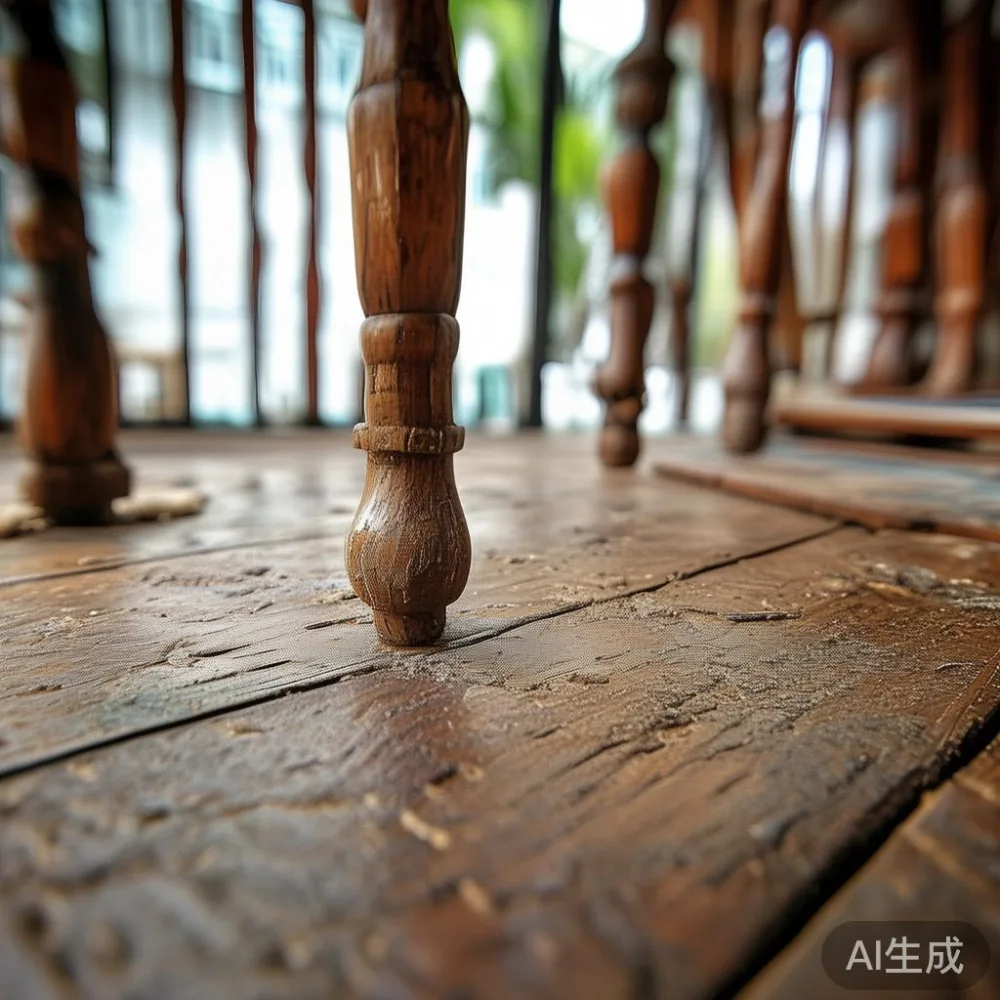
The visible symptoms appear in a predictable order: hairline checks on the end grain of table legs, slight crowning (a gentle hump) across a table top, sticky drawers that bound in their runners, and finally gaps opening up where the breadboard ends meet the top. None of these are defects — they are wood doing its job. The problem comes when furniture is built for a 45% RH climate and dropped into a 90% RH corridor balcony with no breathing room.
Which wood species actually survive a Singapore balcony?
Not all hardwoods behave the same. After watching a stack of samples in a Pasir Ris workshop for eighteen months, the picture is clear. Teak remains the gold standard for outdoor balcony furniture: dense, oily, and naturally resistant to fungal attack. Its movement coefficient is roughly 20% lower than oak, which means a teak balcony chair will shift about 2.5 mm across a 60 cm seat over a full humidity year instead of 3 mm. For owners who want a warmer tone, white oak is acceptable but must be finished on all six sides, including the underside of every stretcher. Walnut cups badly above 80% RH and is best kept indoors. Rubberwood, the budget workhorse of many regional factories, holds its shape well but needs a sealed finish or it turns grey and fuzzy within one wet season. Engineered boards (plywood with veneer, MDF with laminate) are dimensionally stable but fail in a different way: once the humidity penetrates a chipped edge, the core swells and never recovers. For a 1.8 m balcony dining table that will see daily rain splash, ask for marine-grade plywood cores with a 1.5 to 2 mm teak or oak veneer — the structure stays put while the veneer hides small movements.
Joinery matters as much as species. Mortise-and-tenon, doweled, and traditional Chinese finger joints all allow wood to swell without splitting the surrounding boards. Staples, brad nails, and glue-only construction do not — they let go the third time the timber expands. A solid wood sofa frame built with through-tenons and draw-bored pegs will outlast a stapled frame by a factor of three in this climate. The same applies to bed frames, wardrobes, and nightstands; if you can rock the piece slightly and hear creaks from the joinery rather than the floor, the construction will not survive the next monsoon.
How do I choose a budget under1000 for a study?
A practical study desk under S$1,000 for a humid Singapore home should be a compact 120 cm x 60 cm solid rubberwood or sealed oak top on powder-coated steel legs, paired with one closed drawer and one open shelf, sourced from a maker who kiln-dries stock to 10% to 12% moisture content and applies a moisture-cured polyurethane finish on all surfaces including undersides.
That single answer covers the three non-negotiables for a sub-S$1,000 study piece in this climate: small footprint (a 120 cm desk fits a standard 1.2 m study nook in a Punggol 4-room flexi flat without blocking the window), proven moisture-controlled timber (kiln-dried rubberwood moves about 30% less than air-dried stock), and a fully sealed finish (moisture-cured polyurethane resists the 80% RH night cycles that cure ordinary lacquers). Add a closed drawer for cables and paperwork, and you have a study that handles Singapore's humidity without warping or growing mould. Total landed cost in SGD: roughly S$650 to S$900 for the desk, S$80 to S$150 for delivery up the lift to a HDB on the 14th floor (the standard 2.4 m wide corridor and 1.0 m lift door will accept any piece up to 90 cm wide without tipping it sideways), and zero GST on the desk itself if the order is shipped directly from a regional factory. Keep the desk away from the aircon vent by at least 60 cm, and run a small 25-watt USB dehumidifier in the drawer overnight during the December monsoon.
What's the smartest layout for a 6 to 12 sqm HDB balcony?
Measure the lift door and the corridor turn first. Most HDB blocks built after 2015 have a 1.0 m wide x 2.1 m tall lift opening and a corridor that allows a 2.4 m straight run before any 90-degree turn. That means a balcony dining table longer than 1.6 m usually has to come in two halves and be joined on site, and any wardrobe deeper than 55 cm will not clear the lift. For a typical 7 sqm balcony — common in Punggol Northshore — the comfortable plan is a 140 cm to 160 cm dining table for two, two stackable solid wood chairs with a 45 cm seat width, a 90 cm x 45 cm console that doubles as a sideboard, and one slim 40 cm wide nightstand repurposed for potted herbs. Leave a 70 cm circulation lane between the dining edge and the railing. That lane also acts as an airflow corridor, which slows the rate at which humidity climbs after a storm.
For owners who treat the balcony as a second living room, a small post-modern accent chair canada inspired silhouette — a low, wide-seated chair with a curved back — works surprisingly well as a reading seat. It gives the balcony a French light luxury feel without the weight of a full lounge suite, and a 1.2 m wide version fits through a standard lift with 12 cm to spare on each side. Pair it with a 70 cm round marble table (a sealed Carrara top on a powder-coated base) and the space reads as a quiet breakfast corner rather than a utility area. MIDHILL's balcony collections follow this exact logic — small footprints, kiln-dried timber, and finishes rated for 85% RH service — and the brand's pieces routinely ship into Tampines, Bedok, and Punggol lifts without the buyers needing to request a split delivery.
Can I really leave solid wood on the balcony year-round?
Yes, provided the piece is built for outdoor service and the owner accepts a small maintenance routine. The pieces that survive uncovered through two full monsoon cycles in Singapore share four traits: teak or properly sealed white oak, through-tenon or wedged dowel joinery, stainless steel 304 or 316 fixings, and a finish reapplied every 14 to 18 months. A teak dining table left fully exposed will silver within nine months and then remain stable for ten to fifteen years — the silver patina is actually oxidized teak oil and protects the wood underneath. Owners who prefer the honey-brown colour spend about S$120 to S$180 per year on teak cleaner and sealer, applied in two weekend sessions, typically in March and September.
For pieces that should not live outdoors permanently — a bedroom-style nightstand, a fabric-upholstered solid wood sofa, a wardrobe with interior drawers — the rule is to keep them under a roof overhang of at least 90 cm and at least 30 cm away from any glass railing. Direct rain is the enemy; high ambient humidity is merely a nuisance. A covered balcony in a Bishan or Toa Payoh condo that sees rain only on the windward side will hold indoor-rated furniture for a decade with no refinishing at all. Move the same wardrobe to an uncovered service balcony in Tuas and you will refinish the drawer fronts within three years. The furniture has not changed. The microclimate has.
How should new arrivals acclimatise before they hit the balcony?
Let every solid wood piece sit in its final room for 7 to 14 days before loading it with books or tableware. That window lets the timber equalise to your specific balcony or corridor microclimate instead of the factory's 12% RH storage room. Skip the plastic wrap the moment the cartons are open; trapped moisture will fog the finish within 48 hours. Wipe all surfaces with a dry microfibre cloth on day one, day three, and day seven, and keep a small 10g silica gel packet inside any closed drawer or wardrobe compartment for the first month. If a hairline check appears on the end grain of a table leg during this settling period, do not panic — it will usually close on its own once the indoor RH drops in February.
For buyers sourcing from regional factories, ask the maker for the kiln-dried moisture content reading. A reputable supplier will quote 10% to 12% for indoor pieces and 12% to 14% for outdoor balcony furniture. Anything above 16% means the timber was not dried properly and will move excessively once it hits a Tampines afternoon. Free shipping over US$350 from regional makers often still works out to S$80 to S$150 in landed Singapore delivery for a single dining table, with 14-day returns and a 10-year structural warranty on the joinery — terms that make it sensible to order a piece, live with it for a week, and send it back if the movement looks wrong. MIDHILL sends the same spec sheet with every balcony order, and their lifetime refinishing service has become a quiet favourite among condo owners in the East who would rather refinish a solid wood dining table after eight years than replace it.
What about marble, wardrobes, and nightstands on a humid balcony?
Marble behaves differently from wood but suffers the same moisture fatigue. A 70 cm round marble table on a covered balcony is fine for ten to fifteen years; on an uncovered balcony the surface will etch within two years from acid rain alone, and the resin backing can delaminate if water sits under the slab. Ask for a penetrating sealer applied at the factory and reapply every 12 months. The steel or aluminium base should be powder-coated, not painted, and the feet should have plastic glides to stop capillary moisture climbing into the legs.
Wardrobes placed on balconies need ventilation gaps at the back — at least 25 mm between the wardrobe back and the wall — and the back panel itself should be 9 mm to 12 mm plywood rather than MDF, because MDF swells irreversibly. Sliding doors survive humidity better than hinged doors because they do not depend on a perfectly square carcase. A slim 45 cm wide nightstand on a balcony is the easiest piece to keep happy: small mass means small movement, and a 5 mm gap left at the back during installation will hide most of the seasonal shift. MIDHILL's balcony wardrobes ship with 30 mm rear spacers already fitted, which is why their East Coast customers report zero mildew complaints after three wet seasons.
A short routine that protects a balcony set for a decade
Wipe down every solid wood surface once a week with a dry microfibre cloth. Once a month, clean with a pH-neutral wood soap and warm water, then dry thoroughly. Every six months, inspect the joinery on the dining table, sofa, and wardrobe — a 30-second check with a torch catches loose tenons before they become structural. Every fourteen to eighteen months, refinish outdoor teak and outdoor oak with a hardwax oil or marine-grade sealer. Keep at least one 20 g silica canister inside each closed cabinet. Run the aircon in dry mode for 30 minutes on evenings when the RH climbs above 88%, even with the balcony door closed — the negative pressure pulls dry air into the balcony and slows the moisture climb on timber surfaces.
The numbers behind that routine are simple. A S$2,200 solid wood dining table, a S$950 two-seater solid wood sofa, a S$1,400 wardrobe, and a S$480 nightstand represent about S$5,030 of balcony furniture. Eighty Singapore dollars a year in cleaner, sealer, and silica protects that investment for ten years at a cost of S$800 — a 6.4-to-1 ratio over the lifetime of the pieces. Owners who skip the routine typically replace the dining table top after year six for S$650 to S$900, the sofa frame after year four for S$400 to S$600 in reupholstery, and the wardrobe back panels after year three for S$200. The math is not subtle. A balcony in Tampines, Bedok, or Punggol is one of the harshest furniture environments in the world for solid wood, but with the right species, the right joinery, and twenty minutes of care a month, a well-made set will still be hosting weekday dinners long after the next three HDB en-bloc cycles have come and gone.